
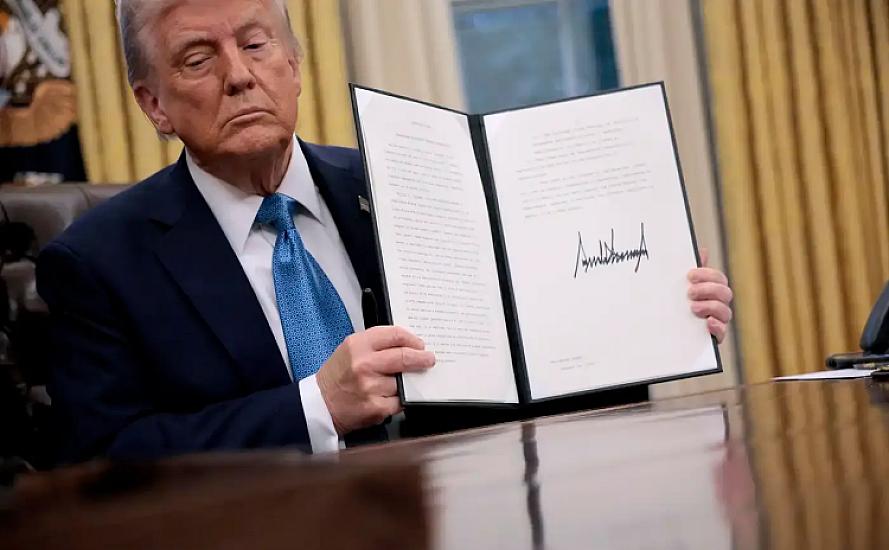
As is known, US President Donald Trump has proposed the Peace Council for Gaza and sent official invitations to the leaders of a number of countries to join the council.
Medianews.az reports that on January 20, the "Bloomberg" agency published the list of countries that received an invitation from Trump. The agency noted that the list is incomplete, and several countries whose names could not be confirmed were not included on this list.
- Germany
- Albania
- Argentina
- European Commission
- Australia
- Austria
- Bahrain
- Belarus
- United Arab Emirates
- United Kingdom
- Brazil
- China
- South Korea
- Finland
- France
- India
- Indonesia
- Jordan
- Ireland
- Spain
- Israel
- Sweden
- Switzerland
- Italy
- Canada
- Cyprus
- Hungary
- Egypt
- Morocco
- Netherlands
- Norway
- Oman
- Pakistan
- Paraguay
- Poland
- Portugal
- Kazakhstan
- Qatar
- Romania
- Russia
- Saudi Arabia
- Singapore
- Slovenia
- Thailand
- Turkey
- Ukraine
- Vietnam
- Japan
- New Zealand
- Greece
- Uzbekistan.
Medianews.az recalls that some experts say the Peace Council for Gaza is essentially an alternative to the United Nations (UN), characterizing it as “Trump’s UN.” According to them, if the plan is implemented, the new council could sideline the UN.
According to the draft charter of the Peace Council, the lifelong presidency will be held by Donald Trump. The council will begin its activities by discussing the Gaza conflict and later move on to discussing other conflicts.
The mandate of member states will be limited to 3 years. However, countries that pay 1 billion dollars each to fund the activities of the council will gain permanent membership. The White House, in a statement posted on the social network "X," evaluated this—that is, permanent membership—as a special opportunity created for “partner countries demonstrating deep commitment to peace, security, and prosperity.”
The draft charter emphasizes that “sustainable peace requires pragmatic thinking, solutions based on sound logic, and a firm determination to move away from approaches and institutions that have repeatedly failed.” At the same time, it notes the “need for a more agile and effective international peacebuilding institution.”