
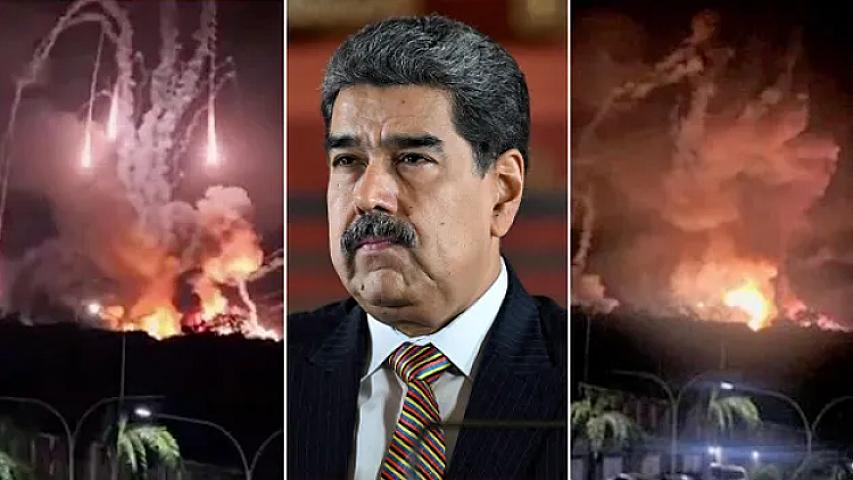
The US military intervention in Venezuela is undoubtedly contrary to international law and is not a behavior to be praised.
At the same time, a regime was established in Venezuela that disregarded not only international law but also its own internal legal system.
In a country with a democratic election experience, applying the practice of election fraud may be perhaps Maduro's most innocent act, and illegitimacy does not stem solely from this. Due to the economic collapse caused by the regime, which has reached the level of a humanitarian disaster, as well as harsh repressions, more than 8 million out of 30 million people have left their homeland.
Imagine, after Maduro tripled the minimum wage in the country, that amount has reached 2.5 US dollars. The national currency, the bolivar, has long been transformed into a worthless piece of paper. Thousands of opposition members and dissatisfied citizens have been killed so far by security forces and paramilitary motorcycle groups called "colectivos" loyal to the regime (analogous to the Basij forces in Iran). The UN had already announced in 2019 that the number of deaths was 7,000...
Returning to the US intervention again. The Trump administration effectively does not recognize international law. Trumpism, the radical right in the US, rejects the imposition of norms, principles, and codes of conduct by international and regional organizations on states, considering this contrary to national sovereignty.
The new US national security strategy announced in December is entirely written in the spirit of political realism. That is, in Trump's global vision, the emphasis is on the power factor, national interest, and current realities rather than idealistic values. This approach is unacceptable and risky even for small countries like ours. It follows that Russia, being the largest and strongest state in the region, has the right to impose its will on us...
Regarding the connection of the Venezuela event to Ukraine, the idea that Trump "sold Ukraine to Russia in exchange for taking Venezuela" cannot be true. First of all, Russia did not have serious control in Venezuela for the US to seek Moscow's permission to intervene there. Trump wants to reach a consensus with Russia on the Ukraine issue, but the peace plan on the table, the US preparing to provide security guarantees for Ukraine at the legislative level, and the promise of serious support for Ukraine's restoration after the war to become a viable state, as written in the national security strategy, do not indicate that Ukraine will be sold.
In general, it is necessary to note that Ukraine currently is not so small and weak as to be given away as a gift to any middleman; it has one of the world's most capable and large armies, high-level professional intelligence services, and a strong military-industrial complex.
The idea that the US and Russia sit at the table and divide—or will divide—the world between themselves does not seem like a solid claim. Who will share what with Russia, which has not been able to take Donetsk province in five years (2014-2015, 2022-2026)? Although the international system formed after World War II is currently effectively bankrupt, the current situation should not be confused or equated with the situation that necessitated the Yalta bargain at the end of World War II. The Russian Federation is not a state with the power to dictate terms as the USSR did.
Although the new national security strategy, prepared in the spirit of Trump's "Monroe Doctrine 2.0," declares the Western Hemisphere a priority region, it is wrong to interpret this as the US conceding Europe to Russia and the Indo-Pacific region to China. The strategy itself states the opposite. Although current governments (liberal elites) are strongly criticized in the division regarding Europe, it declares that the US will not allow any rival (enemy) power to dominate in Europe. "We cannot afford to write off Europe, this would be political suicide on the way to achieving our goals," the strategy says.
In conclusion: once again, as we have seen, establishing a harsh regime is neither a way out nor a solution. Contrary to what they think, these types of regimes become more open and more intolerant to foreign interventions.
Şahin Cəfərli,
political scientist