
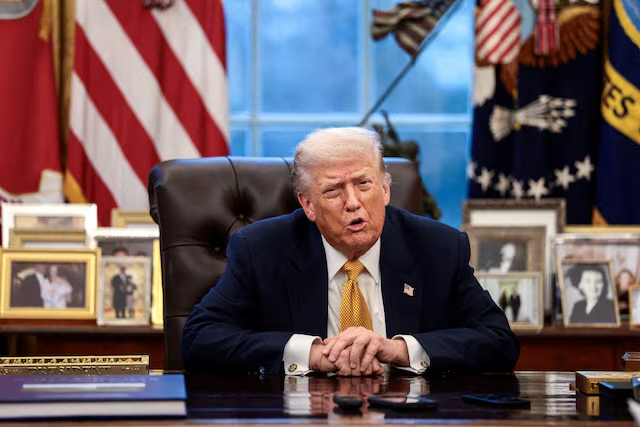
U.S. President Donald Trump has proposed the establishment of a "Peace Council" to resolve global conflicts. Some sources also consider this as an alternative to the United Nations (UN).
Medianews.az, citing "Reuters," reports that Trump has sent invitations to about 60 countries to join the institution. So far, the only country to respond openly and positively to the invitation is Hungary, considered a close ally of Trump.
Other governments are currently hesitant to take a clear stance, and concerns that Trump's council might impede the work of the UN are being raised anonymously.
The "Reuters" agency has obtained the draft charter of the "Peace Council."
According to the draft, the council's lifetime presidency will be held by Donald Trump. The council will begin its activities by discussing the Gaza conflict and later move on to discussing other conflicts.
The mandate of member states will be limited to 3 years. However, countries that pay $1 billion each to finance the council's activities will gain permanent membership. The White House, in a statement released on the "X" social network, described this permanent membership as a special opportunity created for "partner countries demonstrating deep commitment to peace, security, and prosperity."
Italy's Prime Minister Giorgia Meloni, currently on a visit to South Korea, told journalists that her country is "ready to do its part." However, it is unclear whether she specifically meant Gaza or a broader peace initiative.
Canada's Prime Minister Mark Carney said on Sunday that he has accepted Trump's "Peace Council" idea regarding Gaza in principle, but details are still being negotiated.
It should be noted that the UN Security Council approved the mandate for a "Peace Council" focused on the Gaza conflict last November. However, this mandate is valid only until 2027 and is strictly limited to Gaza. Russia and China, which hold veto power in the Security Council, remained neutral on the resolution, arguing that the document did not clearly define the UN's role in Gaza's future.
"Reuters" reports that adding the draft charter to the invitation letters sent to countries for membership in the "Peace Council" has caused serious concern in some European governments. According to diplomats, this council could weaken the UN, which Trump has frequently criticized.
One diplomat described the "Peace Council" as "Trump's UN."
Three other Western diplomats told "Reuters" that if implemented, the new council could sideline the UN. The diplomats confirmed that Trump intends to give the "Peace Council" supervisory functions over conflicts beyond Gaza in the future. Trump has repeatedly declared that he has successfully resolved several international crises.
Among the invitees are France, Germany, Italy, Hungary, Australia, Canada, the European Commission, and the main powers of the Middle East. Hungary's Prime Minister Viktor Orban wrote on the "X" network: "We have, of course, accepted this honorable invitation."
The draft emphasizes that "sustainable peace requires pragmatic thinking, solutions based on sound logic, and a firm resolve to move away from approaches and institutions that have repeatedly failed." It also notes the "need for a more agile and effective international peacebuilding institution."
The UN Secretary-General António Guterres's spokesperson stated in response to "Reuters" that Guterres "believes member states are free to unite in various groups." The Deputy Secretary-General added, "The UN will continue its work within its mandate."
Trump, a Nobel Prize contender, wrote in his letter that the council will convene soon, stating: "This council will be unique; no such institution has existed before!"
Another senior UN official did not comment directly on the plan but emphasized that the UN is the only institution with the moral and legal capacity to bring all countries, large and small, together.
"If we question this... we will return to very, very dark times," said UN General Assembly President Annalena Baerbock in an interview with "Sky News," noting that the decision is up to individual states.
Trump has long been skeptical of multilateral institutions, especially the UN. He has repeatedly criticized the efficiency, expenses, and accountability of international organizations, saying they often do not serve U.S. interests.
According to the UN, the U.S. should pay 22 percent of the organization's regular budget and currently has a debt of $1.5 billion.
The White House revealed the names of some individuals who will be part of the "Peace Council" last Friday. It was announced that the council will continue its activities following the phase of overseeing temporary administration in Gaza amid a fragile ceasefire since last October.
The council includes U.S. Secretary of State Marco Rubio, Trump's special envoy Steve Whitkoff, former British Prime Minister Tony Blair, and Trump's son-in-law Jared Kushner.
According to Trump's plan, an international council will oversee the Palestinian administration and guide the management of Gaza during the transitional period. Israel and Hamas have also agreed to this plan.
"I believe the process will start with Gaza and then continue as conflicts arise," Donald Trump said in an interview with "Reuters" last week.
Many human rights defenders and experts compare Trump leading a council that will implement administration in foreign territories to a colonialism model.
The White House has not clarified the specific powers of the council members. Palestinians are not listed. It was stated that new members will be announced in the coming weeks.
There is also a separate 11-member "Gaza Executive Council," including officials from Turkey and Qatar. The office of Israeli Prime Minister Benjamin Netanyahu stated that the composition of this council was not agreed upon with Israel and contradicts the country's policy.