
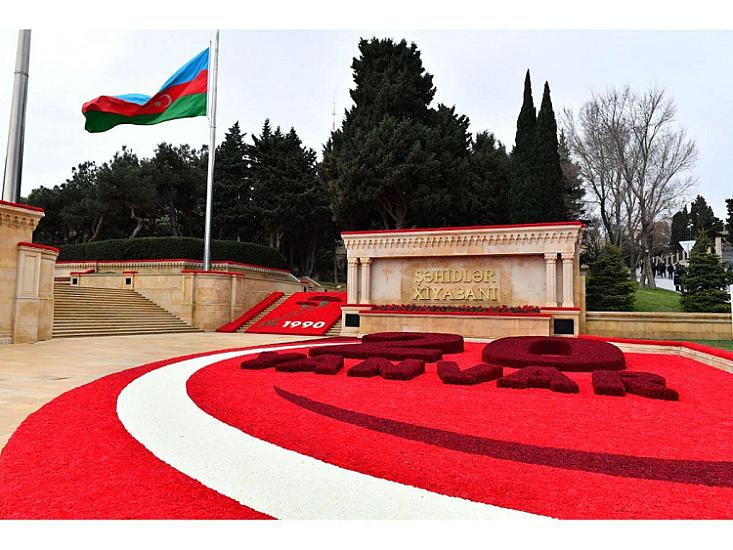
36 years have passed since the tragedy that occurred in Azerbaijan on January 20, 1990.
On the night of January 19-20, 1990, by the order of Mikhail Gorbachev, General Secretary of the Central Committee of the Communist Party of the Soviet Union, units of the USSR Ministry of Defense, the State Security Committee, and the Ministry of Internal Affairs were sent to Baku and several districts of Azerbaijan. The peaceful population was subjected to fire from heavy equipment and various types of weapons and was massacred.
The large contingent of special forces of the Soviet army and internal troops that seized Baku was accompanied by special cruelty and unprecedented savagery. Before the declaration of martial law to the population, soldiers mercilessly killed 82 people and seriously wounded 20. After the declaration of martial law, over several days, 21 people were killed in Baku. In the districts and cities where martial law was not declared—on January 25 in Neftchala and on January 26 in Lankaran—8 more people were killed.
Thus, as a result of the illegal deployment of troops, 131 people were killed and 744 were wounded in Baku and surrounding districts. Among the deceased were women, children, the elderly, as well as paramedics and militia members.
The illegal deployment of troops was also accompanied by mass arrests among the peaceful population. During the operations, 841 people were illegally detained from the capital Baku and other cities and districts of the republic; 112 of them were sent to prisons in various cities of the USSR.
Soldiers opened fire on 200 houses, 80 cars, including ambulances; fires caused by incendiary bullets destroyed a large amount of state and private property.
The victims of January 1990 are symbolically called the "January 20 martyrs." In total, Azerbaijan has 150 people titled "January 20 martyrs."
Immediately after the tragedy—on January 21, 1990—the National Leader Heydar Aliyev, together with family members, went to Azerbaijan's permanent representation in Moscow to show solidarity with his native people, sharply condemned this bloody operation carried out by the USSR leadership, and exposed those responsible for the operation.
The January tragedy was not only a national mourning but also demonstrated the unshakable will and fortitude of the Azerbaijani people. Despite the brutality and cruelty of the Soviet army and the imposition of martial law in Baku, on January 22, the Azerbaijani people held a funeral procession in the capital’s "Freedom" square for the burial of the January 20 martyrs. Nearly 2 million people participated in the burial ceremony at the Alley of Martyrs. At the demand of the people, an extraordinary session of the Supreme Soviet of the Azerbaijan SSR was convened, and a decision was made to lift the martial law in Baku city, but most of the republic's leadership, fearing the people's anger, did not attend the session.
On March 29, 1994, on the initiative of the National Leader Heydar Aliyev, the highest legislative body—the National Assembly—gave the January 20 tragedy the first legal-political assessment. Since then, January 20 is commemorated annually in Azerbaijan as a National Day of Mourning. Every year on January 20, officials and ordinary citizens visit the Alley of Martyrs to pay tribute to the victims of the January 20 tragedy.
According to the special event plan, to ensure the safety of visitors, on January 20, from 08:00 until the end of the ceremony, traffic of vehicles will be restricted on streets and avenues leading to the Alley of Martyrs. The use of private cars is advised to be minimized and preference given to public transport in this direction.
On January 20, at 12:00 Baku time, the memory of the martyrs will be honored with a one-minute silence throughout the country; ships, cars, and trains will give sound signals. On that day, as a sign of mourning, the state flags of Azerbaijan will be lowered throughout the country.
To draw the attention of the world community to the Bloody January tragedy, the embassies, diplomatic missions, and Azerbaijani communities abroad are carrying out relevant events.