

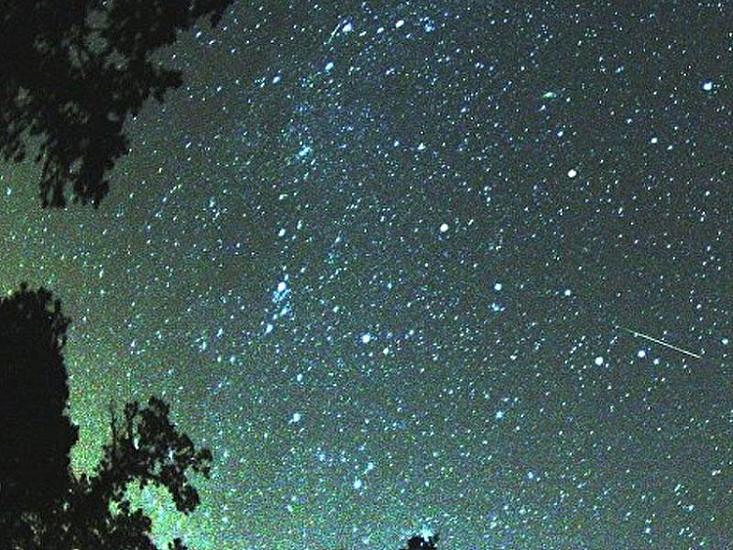

The "Eta Aquarid" meteor shower will be observed from the end of April to mid-May.
Medianews.az reports that according to the information from the Astrophysics Department of the Faculty of Physics at Baku State University (BSU), the peak activity of the meteor shower will occur on May 5-6.
Meteors enter the Earth's atmosphere at a speed of approximately 66 km/h and, due to their high speed, leave long and bright trails across the sky. Since they appear to come from the direction of the Aquarius constellation, this meteor shower is called "Eta Aquarid."
The source of the "Eta Aquarid" meteor shower is related to Halley's comet, one of the most famous periodic comets of the Solar System. Although Halley's comet has been observed since ancient times, its periodic nature was first determined by Edmond Halley. He calculated that the comet he observed in 1682 was the same object with an approximately 76-year period as the comets recorded in 1531 and 1607. The reappearance of the comet in 1758 confirmed this calculation, and the comet was named in his honor. When approaching the Sun, the ice and dust on the comet's surface sublimate and leave a wide and long trail along its orbital path. The Earth encounters this trail twice a year, resulting in the observation of the "Eta Aquarid" meteor shower in May and the "Orionid" meteor shower in October.
Observation of the "Eta Aquarid" meteor shower is possible from the city of Baku, but there are some limitations. Since it is located in the Northern Hemisphere, the radiant point of the meteors does not rise very high above the horizon. Therefore, the number of meteors observed is lower compared to the Southern Hemisphere. Nevertheless, with favorable weather conditions and in areas away from city light pollution, it is possible to see 10-20 meteors per hour during the early morning hours (from 02:16 to 05:01). Areas outside the Absheron Peninsula, which have darker sky conditions, are considered favorable for observation.
The "Eta Aquarid" meteor shower is significant not only aesthetically but also for scientific research. Spectral observations of meteors allow determining their chemical composition, and this information is used to study the primary characteristics of comet material. The ionization and energy transfer processes occurring when meteors enter the Earth's atmosphere allow investigating the interaction mechanisms of high-energy particles with the atmosphere. //Milli.Az