
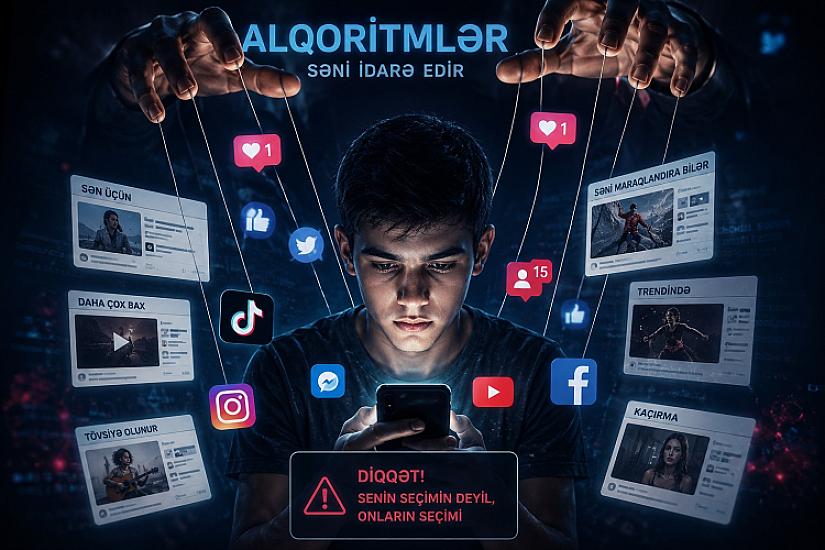

Previously, people chose which book to read, which TV program to watch, or which newspaper to buy by themselves. Today, however, the majority of videos and news appearing before millions of young people are determined by the algorithms of platforms. Watching one video or liking one post is enough to face countless materials with similar content in the following days.
Given this, a question arises: do young people really learn what they want, or do the algorithms of social media platforms form thoughts and interests according to the content they present to them?
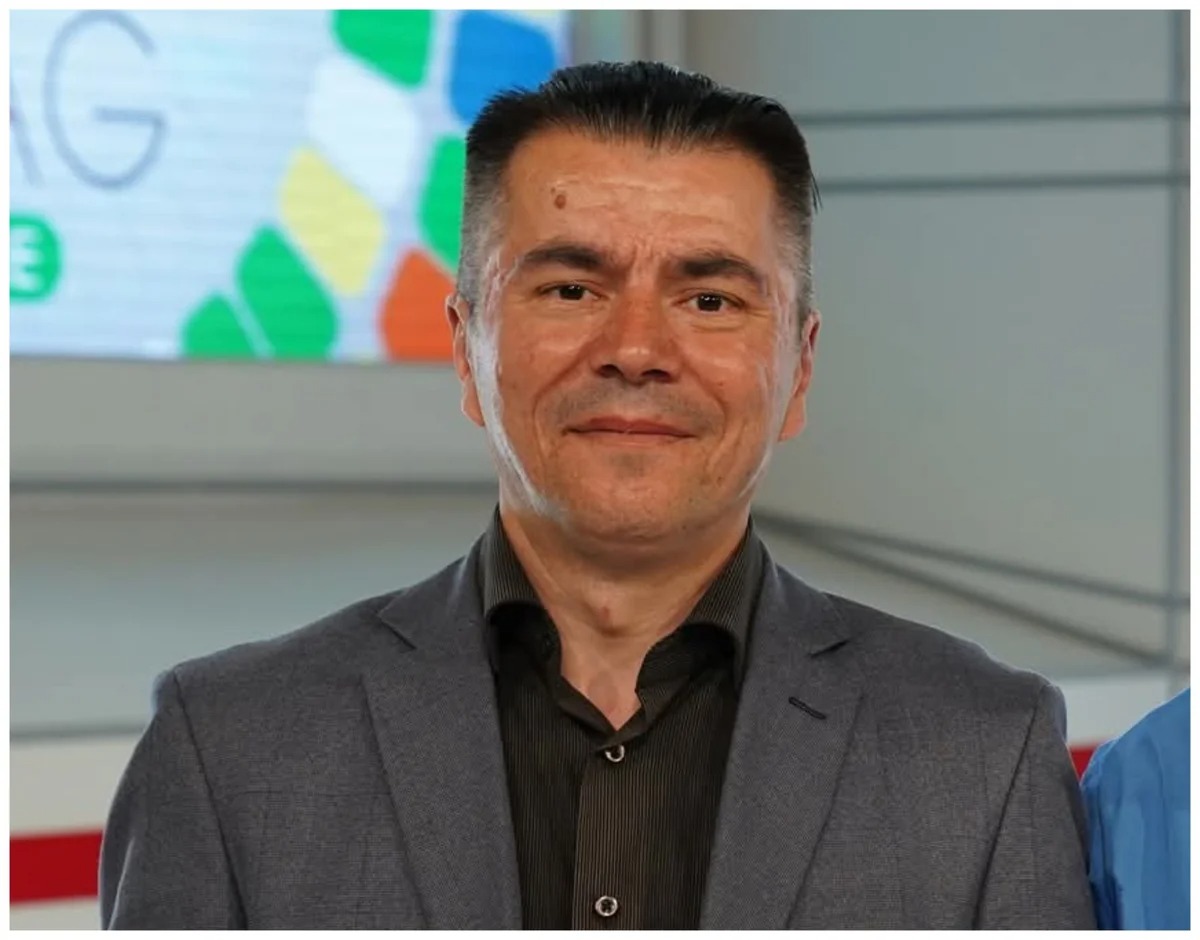
Speaking to Medianews.az on this topic, sociologist Naib Niftəliyev noted that this issue is one of the quite current and topical problems: “Of course, it is normal for people to perform certain searches on the internet, to choose or to watch something. These searches aim to meet certain social interests, expectations related to individual behaviors, as well as to form business relationships. Currently, those who use the internet for various personal purposes constitute a significant majority in society. It is clear that every person tries to benefit from the internet for both business and personal and useful purposes. However, the algorithms here are, to some extent, formed to optimize choice opportunities.
It is known that recently these algorithms function excessively actively and flexibly. They almost direct human behavior, activity, and motives into a different direction, presenting overt or hidden advertising content, thus directly influencing the subconscious. In such a case, it is inevitable for these algorithms to become bearers of a certain influence mechanism. That is, whether we like it or not, whichever content we prioritize, more topics of that kind appear before us. People should be aware of this issue and be attentive and cautious about the process. The best alternative is for people to search in different directions and not repeatedly use the same content. It is entirely possible to understand this situation and find solutions.
It should be noted that technologists and those developing algorithms calculate all these subtleties and details in advance. Therefore, to some extent, ethical barriers and ethical recommendations should be expected on platforms, and people’s choices should be respected. It seems that a person should know how to keep some distance from technology and also understand the principles and subtleties of these algorithms more or less. Here, there are very complex, subtle, and sensitive points. On the one hand, technology directs and socializes you; on the other hand, it is not directly the carrier of social qualities. We are the ones who transmit and upload this content, but later we are somewhat powerless against it. As a result, some benefit from this process, while the losses for the vast majority exceed the gains. For example, a person wanting to find information about a problem within 5 minutes faces hundreds, thousands, or even millions of similar alternatives. Thus, a 5-minute task can sometimes extend to 5 days or even 5 years, causing great uncertainty.”

According to the sociologist, the important point here is that the algorithms cannot directly control human thought: “They simply receive a technogenic signal based on the content the user searches for and try to consecutively present other content accordingly. This is already a well-known reality that should be kept in focus.
Another important issue is knowing how and under what conditions to benefit from that content. For example, when searching for scientific electronic books, having various options appear is interesting for us. Especially in scientific research, this multiplicity is very important and valuable in terms of drawing conclusions. But suppose we are searching for any literary work dedicated to ‘Qaçaq Nabi’ and different contents, works by various authors, or films appear; this already creates confusion. Because there are significant differences between artistic imagination and real factual approaches, and these differences somewhat limit the synthesis of fact-based approaches with imaginative products. To eliminate this difference between reality and the desired, it is important for platform algorithms to work deeply not only on the surface but also in specific content directions.
Along with learning to express the needed content properly, we must also be able to reject what is unnecessary, skip over it, or find other useful alternatives. Generally, today’s youth are informed about these matters. It is just that there is a large majority who are unaware of this, which is more a matter concerning other age groups than youth.”
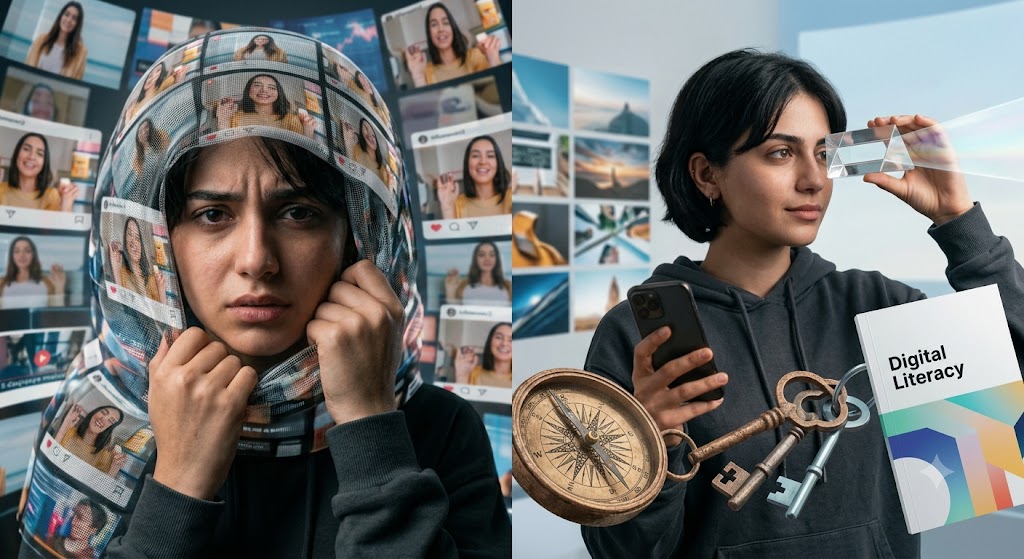
N. Niftəliyev noted that there is a great need to form digital culture regarding information consumption right now: “In this regard, certain security measures should be taken to eliminate extreme directions, digital and social media addiction in the context of intellectual development and society's information safety. In any case, if we intend to read any book, select the content we want, or get acquainted with it, we should focus more on the essence of the content than on its visual presentation. When directed to the correct content and when using keywords correctly during searches, such problems can be significantly eliminated.
A person must always be prepared for such uncertainties and the waves created by algorithms. Because as time passes and technology becomes more accessible, the potential influence directed at us also increases. As digital influences grow, in the future, certain virtual images in 3D, 5D, or even 7D format may turn into real content. In the future, it will be essential to consider all these, develop preventive social behavior models beforehand, inculcate them in society, and determine stable goals of digital ethical behavior.”

Elvin Abbasov, chairman of the Azerbaijan Information and Communication Technologies Industry Association, told Medianews.az that the issue we talked about is one of the most fundamental dilemmas of modern digital philosophy, cognitive psychology, and cybersociology.
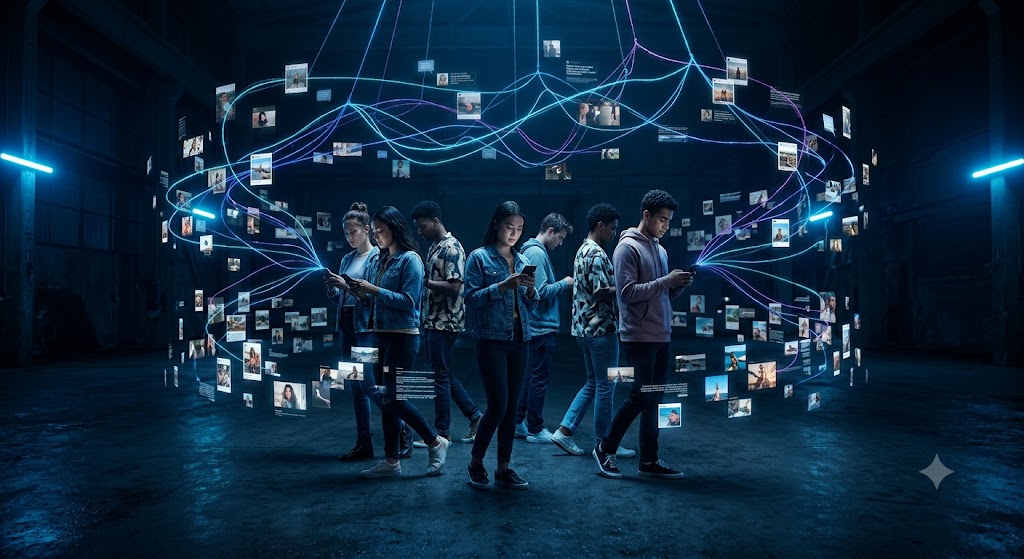
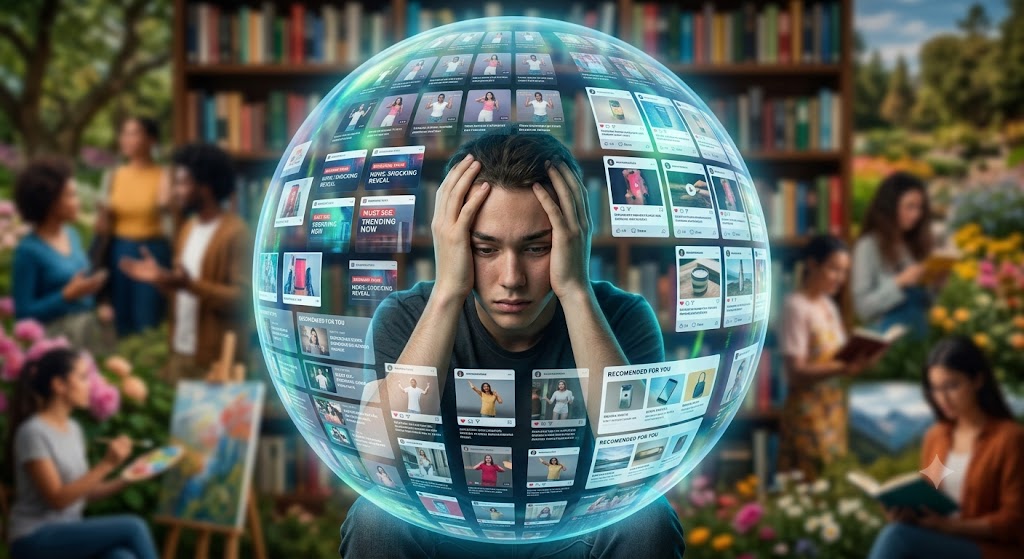
According to E. Abbasov, this complex situation regarding the extent to which human will is independent in the digital environment can be explained on two interaction planes: “On the first plane, it is an undeniable truth that algorithms of the software applied by platforms form thoughts and interests corresponding to the content presented to young people. Algorithms are not just passive filters. They are active architectural structures that use neuro-psychological triggers and dopamine cycles to maximize the user’s stay duration on the platform. When young people leave a small digital trace on any topic (for example, a certain political view, lifestyle, or subculture), the system completely closes alternative views to them and traps them inside the ‘Filter Bubble.’ When the human brain is regularly fed with similar types of information, its critical thinking ability weakens and starts accepting the presented reality as the only truth. That is, young people often think they learn something with their free choice, but in reality, they are participants in a scenario where algorithms manipulate and reshape their internal biases, tastes, and interests.”

On the second plane, it should be remembered that algorithms do not create these interests from scratch; initially, they reflect the user's internal tendencies and hidden desires like a mirror. The problem lies not in what young people want, but in the algorithm’s aggressive hypertrophy (excessive enlargement) of that initial desire and depriving the person of other intellectual stimuli. In the modern digital world, young people's truly learning what they want and preserving their intellectual sovereignty is only possible with high-level cyber-hygiene and digital literacy habits. Unless users consciously seek different and contradictory topics, reset the platforms’ digital memory from time to time, and keep their critical thinking active, they will not be owners of their thoughts but remain merely products of the digital profile designed by algorithms.”

Answering Medianews.az’s question, clinical psychologist Nigar Eyvazova said that it is actually not correct to give a definite answer on this subject: “A person enters social media with certain interests, but algorithms function as a system that strengthens those interests. Psychologically, our brain tends to accept repeated information as more familiar and true. When we encounter content on the same topic repeatedly, it starts to seem more important and real to us. For example, a young person accidentally watches a video about a certain topic. The algorithm considers this interest and presents more content in the same direction in the following days. After a while, such a young person might get the impression that the whole world only talks about that topic. However, this is not the full picture of reality; it is a selected stream of information presented by the algorithm.”
Adolescence and youth are among the most sensitive stages where personality, values, and worldview are formed. During these ages, people determine who they are, what they will believe in, and which path they will choose in life. If the information they encounter during this process is not diverse and consists only of similar content selected by an algorithm, their thinking environment may become limited. This can lead to weakening critical thinking skills, increased intolerance toward different views, and more social comparisons.”
The psychologist emphasized that especially continuous watching of content showing an ideal lifestyle, success, and beauty can result in psychological outcomes such as loss of self-confidence, a feeling of dissatisfaction, and anxiety: “Facing such problems during the personality formation period can cause later psychiatric disorders, personality disorders, neurotic and affective disorders.
Overall, we can say this: social media is neither good nor bad. Everything depends on how we use it. When used correctly, these platforms are very powerful tools for learning, developing, and acquiring new skills. The problem is not the existence of the algorithm but the user’s lack of understanding of how it works. A person must realize that the content presented is not objective reality. It is a selected stream of information based on their previous behavior.
Young people should learn to ask themselves: “Do I watch this because I really find it interesting, or just because it repeatedly appears before me?” It is very important to get information from different sources, read various viewpoints, and refer to books and reliable sources outside social media.
Parents should not limit themselves only to restricting screen time. They should talk with their children about the content they watch, ask questions, and develop critical thinking skills together.
Algorithms try to control your attention, but whether they control your thoughts is your choice. One of the important indicators of psychological health is being able to question information, be open to different ideas, and base decisions not only on the content presented but also on your values and critical thinking. Use social media, but also be aware of how it directs you.”
Nailə Qasımova,
Medianews.az
Note: The article was prepared on the topic “Physical and moral development of children and youth” with the financial support of the Media Development Agency of the Republic of Azerbaijan and in accordance with the competition conditions.