

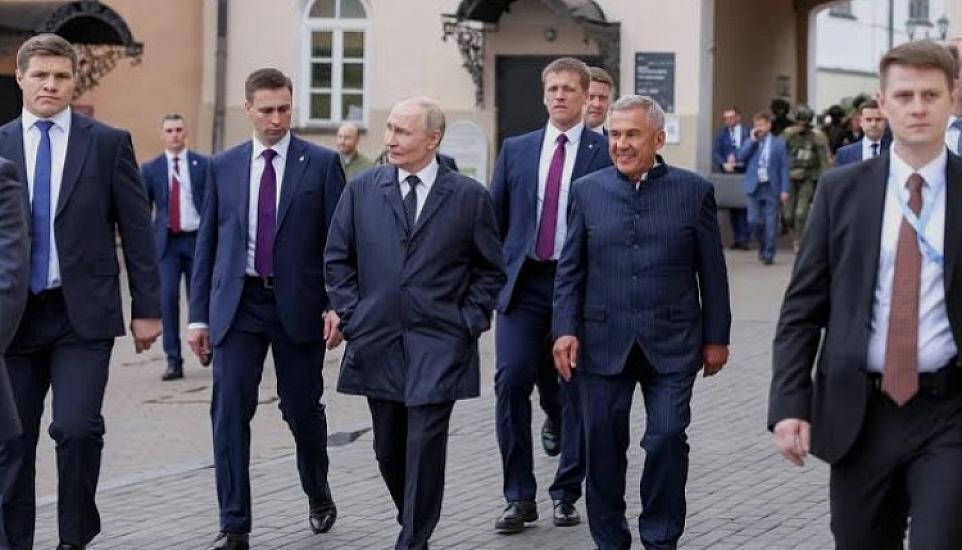

Russian President Vladimir Putin continues to hold international forums within the country as if nothing has happened and to give speeches about cooperation at these events.
However, the possibilities for cooperation with Russia, which is conducting an aggressive war, are not broad. The next forum was held on June 17-19 in Kazan, the capital of Tatarstan. This time, Russia hosted the ASEAN summit (Association of Southeast Asian Nations). Officials from countries such as Brunei, Vietnam, Indonesia, Cambodia, Laos, Malaysia, Myanmar, Singapore, Thailand, the Philippines, and East Timor participated in the summit. While the summit was taking place, Ukrainian drones were striking fuel centers in Moscow. In his speech at the summit, Putin did not touch upon the topic of the war. The Russian President ignores the drone strikes by Ukraine and the fuel crisis faced by the annexed Crimea.
Before the summit, Vladimir Putin met with Turkey's Foreign Minister Hakan Fidan in Kazan. Hakan Fidan had discussed various issues with his Russian counterpart Sergey Lavrov in Moscow one day prior to the meeting with Putin. In addition to Lavrov, Hakan Fidan also held talks with Sergey Shoigu, the Secretary of the Russian Security Council.
The forums held in St. Petersburg and Kazan should indicate that Russia, which is conducting an aggressive war against Ukraine, is not completely isolated from the international community. This is the Kremlin's goal. Before Kazan, Putin had participated in the economic forum held in St. Petersburg. While the forum was being held in St. Petersburg, Ukrainian drones were striking fuel centers in the city. During the forum in Kazan, Putin met with several leaders of Asian countries. The Russian President also proudly noted the participation of leading business representatives from ASEAN member countries at the Kazan forum.
The summit in Kazan has drawn the attention of Beijing. The President of the Philippines, Ferdinand Marcos, also attended the summit and held bilateral talks with Putin. Beijing was concerned about the Philippine President's trip to Kazan and his meeting with Putin. This is because relations between China and the Philippines are tense. Relations between China and the Philippines have worsened due to the confrontation in the South China Sea. There are frequent clashes between Chinese and Philippine military vessels. It is no coincidence that China has imposed sanctions against the Philippine Defense Minister. The entry of the minister and his family members into the People's Republic of China has been banned.
Another factor escalating tensions is China's deployment of mobile platforms near Philippine coastal waters in the sea. The Philippines believes that China is trying to create artificial islands in the South China Sea through these mobile platforms.
Vladimir Putin's meeting and discussions with the President of the Philippines can be seen as a message from Moscow to Beijing. Although Moscow considers Beijing a strategic partner, the Kremlin is dissatisfied with China's insufficient support for Russia amid the Ukraine war. On the other hand, China is diversifying its oil and gas purchases from Russia and is buying energy carriers at cheap prices. This factor also displeases the Kremlin. Additionally, the Kremlin closely monitors Beijing's increasing dialogue with Brussels and Washington with concern. Under these circumstances, the Kremlin has decided to expand dialogue with Beijing's regional rivals as well.
Elkhan Shahinoglu,
political analyst