

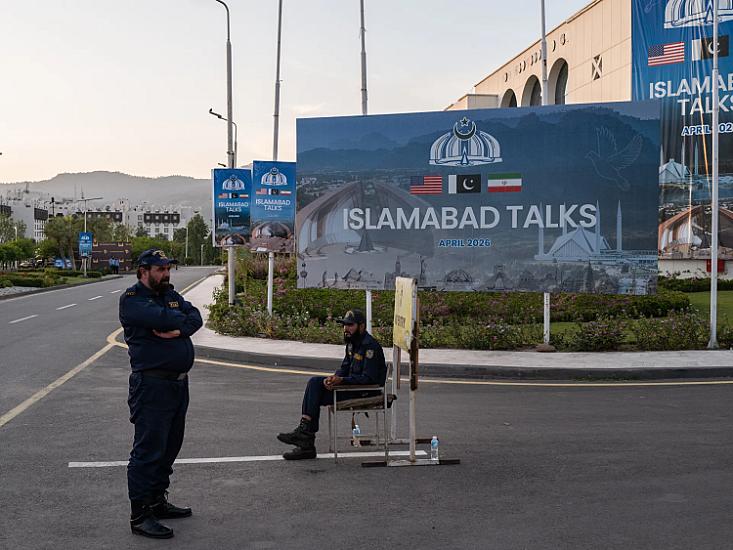

It was expected that the first US-Iran negotiations mediated by Pakistan would end without concrete results. Indeed, before the talks, both sides separately considered themselves victorious and presented maximalist demands. At the same time, both sides also practiced threatening each other in case their demands were not accepted. After the meeting, there were many contradictory points in the statements of the parties.
Usually, contradictions between parties who do not accept each other for a long time and who sit at the negotiation table with the help of mediators cannot be resolved and final results reached at the first meeting and negotiations by reconciling their positions. The first talks generally have the character of the parties defending their positions and disputing the arguments of the other side. In this regard, it would be naive to expect a final agreement in the first round of US-Iran negotiations in Islamabad.
The latest statement by US President Donald Trump regarding the US-Iran negotiations can be evaluated in several ways.
First, these talks can be considered a message addressed to Iran, inside the US, its allies, and the world as a whole. Trump wants to convey that the US is ready to continue negotiations without additional conditions. After the first round of talks, Trump's statement that he could destroy Iran in a very short time – in a day, in an hour – followed shortly by his expression of the idea to blockade the Strait of Hormuz and destroy Iranian ships exiting to open sea indicates that the harsh war rhetoric has been somewhat replaced by milder rhetoric. However, the blockade of the Strait of Hormuz can also be evaluated as a mechanism to pressure and threaten Iran to force it to continue the negotiations.
It is known that protests against a war with Iran are growing within the US and among its allies. American society, although supportive of short-term military operations like those in Venezuela, is not fully in favor of conducting a long-term war and is aware that every day of war with Iran will cost taxpayers billions of dollars. It should also be considered that midterm elections for the US Congress will be held in November. Trump needs to prioritize internal politics targeting the domestic audience and American voters to further elevate his and his Republican Party's influence and to win elections before these elections. The continuation of the war could negatively affect Trump’s and the Republicans’ ratings.
Most European countries allied with the US also do not support the continuation of the war due to energy security and economic interests. The continuation of the war only aligns with Israel's interests. The US government machinery would not want to sacrifice its European allies for Israel’s interests. Therefore, Trump’s statement can be taken as a message to the domestic audience on the one hand, and to its allies on the other, indicating that the US gives priority to diplomatic negotiations, not war.
Secondly, Trump's statement can also be seen as a tactical move. Trump is one of those unpredictable politicians who can take positions diametrically opposed to his previous remarks and make decisions at any moment. In this regard, it is possible to assume that this statement was a certain maneuver made to gain time to prepare for continuing the war by later accusing Iran.
Thirdly, Trump's statement about the next two days can also be considered a point confirming that despite public mutual accusations, behind-the-scenes diplomatic activity is underway. This also makes more credible the possibility that Trump will come out of the war as a winner by making a small concession. The removal of obstacles created by Iran for the movement of commercial ships through the Strait of Hormuz can be accepted as such a concession. Iran has already officially stated that during the 14-day ceasefire period, passage through the Strait will be ensured without obstacles, provided technical issues are resolved. Therefore, the provision of unhindered passage through the Strait of Hormuz can be portrayed as a great victory for the US, and as a result of Trump's pressure and threats against Iran, as well as the blockade of the strait by US warships.
It is now known that a few hours ago Trump stated that the maritime blockade of the Strait of Hormuz was lifted and the passage is open. This means that behind-the-scenes diplomacy has spoken and an agreement has been reached on one of the controversial issues. Hence, it cannot be ruled out that agreements on other issues will be reached.
Qulamhuseyn Alibeyli,
political analyst