
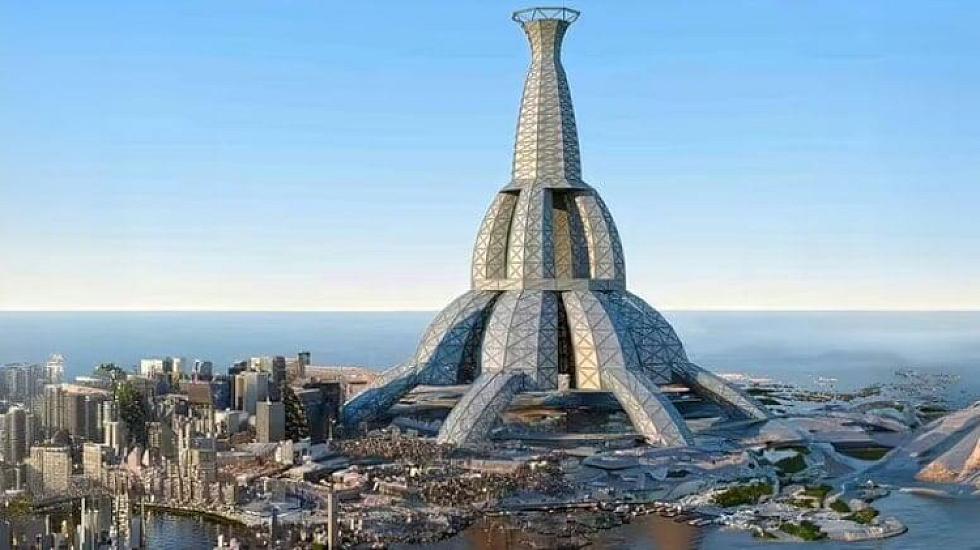
The technologies of the future and the vision of architecture know no boundaries. Engineers are no longer working on building skyscrapers upwards from the ground but are working on projects to "hang" them downwards from the sky. The most striking of these projects is the "Analemma Tower," which surpasses Mount Everest (8848 meters), the highest point in the world, in height.
According to Milli.Az, unlike the buildings we know, this structure is not fixed to the ground. According to the project, the building will be attached with steel ropes to an asteroid orbiting the Earth and will extend downwards from the sky. This method will measure the building’s height in kilometers.
The building could rise to approximately 32,000 meters (32 km) above the Earth’s surface. This means it is about 4 times taller than Mount Everest.
The building will not remain stationary in one place. Together with the orbit of the asteroid to which it is attached, it will trace a large number "8" daily over the Earth, passing over different cities (for example, New York and Dubai).
The building will be powered by solar energy. Since there are no clouds in the upper layers of the atmosphere, the solar panels will operate at maximum efficiency.
Water will be supplied through internal circulation and a condensation system that collects from clouds and rainwater is planned.
How will people live there?
The air pressure and temperature in the upper parts of the building differ greatly from those at the Earth’s surface (negative temperatures and vacuum effect). Therefore, it is not possible for people to live on the top floors of the building without special protective clothing or fully isolated rooms. However, the lower floors are intended for residential complexes, offices, and entertainment centers.
For now, this project remains a theory and a visual concept. Bringing an asteroid into orbit and controlling it is still very difficult for current technology. Nonetheless, this idea is considered an important step demonstrating where engineering could go in the future.