

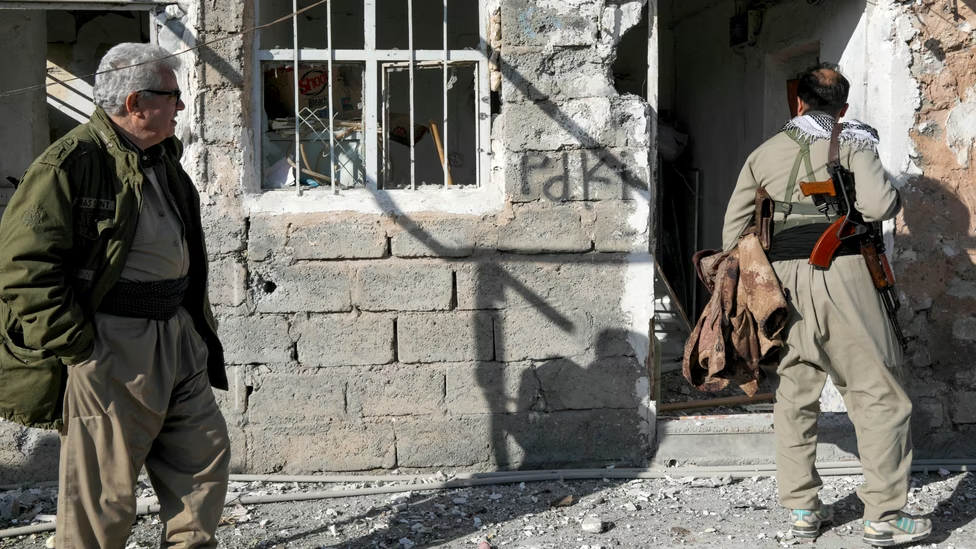

"Armed groups consisting of Iranian Kurds, located in Iraq and known for their pro-US stance, are preparing special units to deploy into Iran." According to Medianews.az, this is stated in an article published in the US newspaper "The New York Times".
The article was written by Julian E. Barnes, a journalist who has long covered US intelligence and international security issues. He was assisted in preparing the article by Kristian Triebert from The New York Times' visual investigations team, editor Parin Bahrooz, and the newspaper's UN bureau chief Farnaz Fassihi.
The article, citing Iraqi officials and responsible persons of organizations consisting of Iranian Kurds, emphasizes that the deployment of armed Kurds into Iran could open a new front in an already expanding conflict: "According to information, the US Central Intelligence Agency secretly developed a program late last February, before the war with Iran began, under which light weapons were supplied to Iranian Kurdish forces in Iraq. The purpose of the program was to weaken Iran and destabilize it.
Nevertheless, the White House spokesperson denied reports that President Donald Trump approved the Kurds to start an armed uprising in Iran. The spokesperson stated that these claims are completely false.
Since February 28, the US and Israel have been bombing Iran. As a result of the attacks, the country's supreme religious leader and other high-ranking officials have been killed. Strikes have been carried out on various regions of Iran, including government and security facilities near the Iran-Iraq border.
According to information, at a time when battles are expanding, US officials are discussing how militarily beneficial the possible intervention of Kurdish forces into Iran could be.
Washington's assistance to the Kurds in such an operation could create an unexpected turn in the course of the war. If the intervention is sufficiently extensive, the Iranian army might be forced to direct its units toward that direction. This, in turn, could provide additional opportunities for US or Israeli aviation to target Iranian soldiers directed toward that area."
The article notes that the US has a long history of cooperation with Kurdish armed groups in Iraq and Syria: "At the same time, there is a widely spread opinion that Washington has abandoned the Kurds in critical moments. The Kurdish people, spread over the territories of Turkey, Syria, Iraq, and Iran, are considered one of the largest stateless ethnic groups in the region.
After the Gulf War in 1991, the US encouraged a Kurdish uprising in Iraq. However, later Washington did not prevent the Iraqi army from ruthlessly destroying Kurdish forces."