

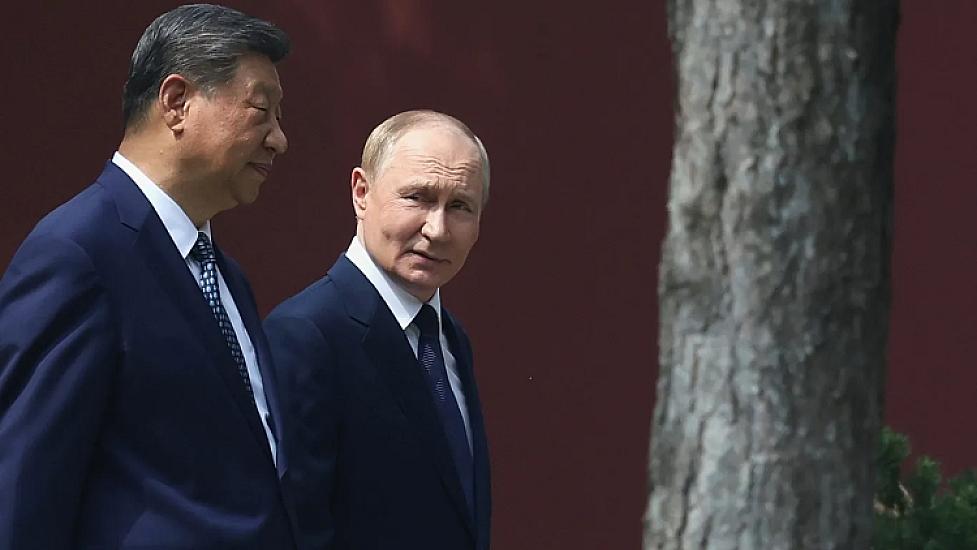

Russian President Vladimir Putin’s visit to China has begun. The Kremlin leader gave a statement in video message form a day before the visit, stating that the relations between the two countries have reached an unprecedented level.
Putin's trip to Beijing coincides with a few days after U.S. President Donald Trump's visit to China, so Putin did not forget to add the necessary clarification to his statement: “The friendship relations between Russia and China are not directed against any country.” The Russian President emphasized economic cooperation between the two countries, recalling that bilateral trade turnover has exceeded 200 billion dollars and that settlements are made in rubles and yuan.
Vladimir Putin stressed that the relations between the two countries are built on mutual understanding and trust, support for each other’s fundamental interests, including sovereignty and territorial integrity. Putin considers the close relations between Russia and China to be of a strategic nature. According to him, such a tandem plays a stabilizing role on a global scale.
The real situation in Russia-China relations is not as Putin describes. These relations have increasingly taken on a one-sided nature. After Russia started its aggressive war against Ukraine in 2022, it directed a large volume of oil and gas that it could not sell to Europe towards China. In 2024, Russia sent goods worth approximately 129 billion dollars to China — the majority of which consisted of crude oil, coal, and natural gas. Overall, since the beginning of the war, China has purchased oil, natural gas, and other energy products worth 372 billion dollars from Russia. In return, Russia has been forced to offer China large discounts.
Thus, Russia has gained the opportunity to continue its aggressive war against Ukraine financed by revenues obtained from China. Therefore, there is an opinion in Western countries that if Beijing influences Moscow, Russia will be forced to stop the war against Ukraine. However, Beijing has no intention of influencing the policy of the Russian authorities. On the contrary, China does not withhold its military assistance to its neighbor.
Although China has stopped direct exports of ready military equipment to Russia, it supplied its neighbor with dual-use goods worth billions of dollars — civilian products and technologies with military applications. These have helped sustain Russia’s defense industry. Russia has become dependent on both the Chinese market and Chinese technologies. This happened because the USA, European Union countries, and the United Kingdom have banned the export of semiconductors, microelectronics, precision machines, and other dual-use goods vital for weapons manufacturing to Russia. This created severe shortages in Russian industry. According to Bloomberg agency, Chinese technology has allowed Russia to continue and even expand the production of missiles, drones, and other weapons, keeping the war economy operational.
After the war ends, Russia's dependence on China will not decrease. Beijing’s influence over Moscow will increase further in the coming years. This aligns with China’s interests. There is another reason why China is not interested in the defeat of the first party in the Russia-Ukraine war, which China’s Foreign Minister Wang Yi openly declared a few months ago during meetings in Brussels: “If Russia loses the war, the United States will target China.” Wang Yi meant that as long as the Russia-Ukraine war continues, the US will not be able to stop China’s rising power. For the same reason, Beijing does not want the regime in Iran to be defeated by the US.
Elkhan Shahinoglu,
political scientist