

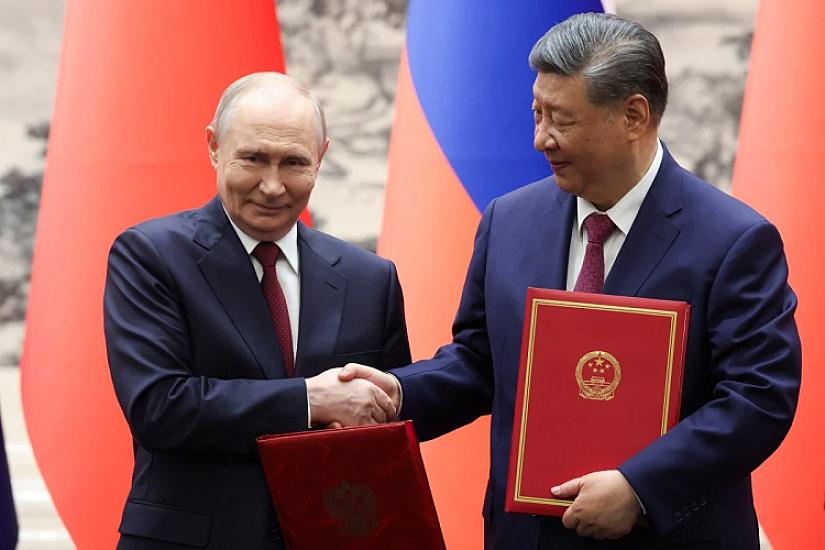

Despite Russian President Vladimir Putin and his entourage highly valuing the results of their visit to China, the parties were unable to reach an agreement on the construction of the "Power of Siberia – 2" strategic gas pipeline between the two countries.
While Russian Presidential spokesman Dmitry Peskov stated that "the parties have broadly reached a certain understanding on the general contours and main parameters of the project," a similar statement has not been released from Beijing on this matter.
Discussions about this pipeline have been ongoing for over 10 years without any results so far. Due to the war in Ukraine, Russia is trying to sell a large volume of gas, which it cannot sell to Europe, to China. Although Beijing continues its partnership with Moscow, it prioritizes the principle of diversification in energy imports, meaning China does not want to be dependent on one country for oil and gas purchases. At the same time, China is trying to take advantage of Russia's difficult situation to lower gas prices.
On the other hand, China is cautious about investing in Russia, viewing its neighbor as a raw materials base. The strategic partnership between these two countries is purely tactical in nature; both are interested in weakening US hegemony.
There are also interesting points in the discussions between Vladimir Putin and his Chinese counterpart Xi Jinping on the Ukraine issue. The joint statement of the leaders emphasized the need to eliminate the initial causes of the Ukrainian "crisis." It is known that when the Kremlin says "initial causes," it refers to the integration of Donbas into Russia, Ukraine's refusal to join NATO, and compliance with other demands. Is Beijing a partner in these Kremlin demands?
The issue is that, like Ukraine, territorial integrity is a "red line" for China as well. Nevertheless, although Beijing recognizes Ukraine's territorial integrity, it is a bystander to Russia's territorial grabs from this country. The war exhausts both Russia and Western countries, which aligns with China's interests.
The joint statement of the leaders stressed the importance of complying with the UN Charter to achieve lasting peace. In fact, it is Russia that has grossly violated the UN Charter by invading a neighboring state's territory and insists on continuing the war.
The joint statement also emphasized the importance of continuing negotiations to resolve the Ukraine conflict. It is Russia that violates this provision. The country's president agrees to negotiations with Kyiv only on the condition that Ukraine accepts Russia's terms. This is not a negotiation but a raising of the white flag by one country before another.
The resistance strength of the Ukrainian army is increasing, and Kyiv will not accept the Kremlin’s terms to start negotiations. To please Beijing, the Kremlin has added the sentence "Russia highly values China’s support for the diplomatic resolution of the Ukraine crisis" to the joint statement.
Meanwhile, Xi Jinping’s phrase during the meeting with Vladimir Putin that "international instability is occurring, and this threatens a return to a ‘jungle world’" attracted attention. Russian politicians and experts may attribute this phrase of Xi Jinping to the US, which started a war against Iran. However, Russia's aggressive war of invasion against Ukraine also constitutes a gross violation of international laws and, in Xi Jinping’s terms, a "return to a jungle world."
"Atlas" Research Center