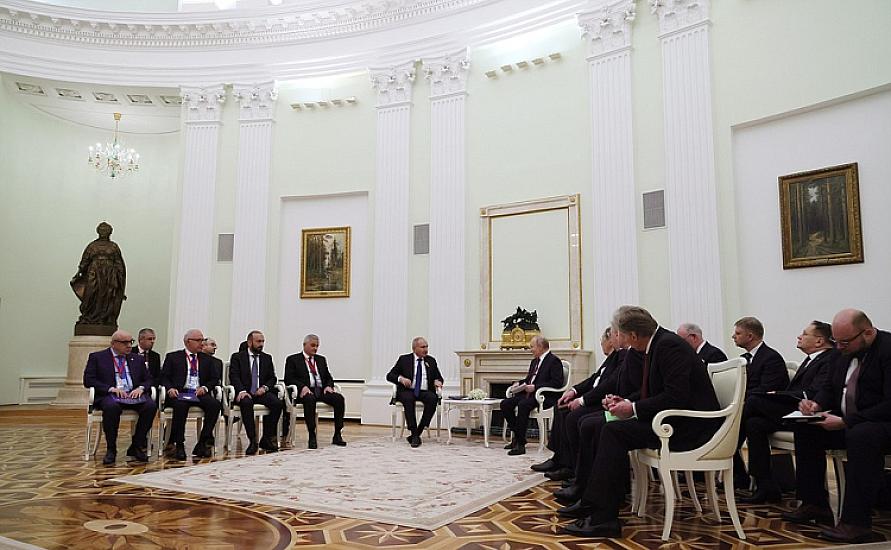
The bold stance exhibited by Armenia's Prime Minister Nikol Pashinyan during his visit to Moscow, in the meeting with Russian President Vladimir Putin, is not being uniformly received by the public.
The Kremlin did not expect the guest to respond with such prepared and rebellious rhetoric, and this seemingly caused disappointment for Putin as well.
It was clearly visible that there were hidden sinister intentions in the statements made by the Russian leadership. Vladimir Putin protested Armenia's rapprochement with the European Union, calling it unacceptable for Yerevan to be represented simultaneously in two different economic blocs. This is clearly interference in Armenia's internal affairs and meddling in its independent policymaking.
Moscow also behaved as if it were the master of the region by trying to dictate its terms as the defender of the interests of the Russian clan and community in Armenia. Pashinyan’s approach of facilitating Russia-oriented parties and politicians' access due to their possession of Russian passports can be seen as direct pressure. Indirectly, this is a message to "take into account the Kremlin’s views."
By trying to create blood from a scratch, the Russian side exhibits a tendency to obstruct regional development and joint construction. This also shows that Russia, which has lost its influence and authority in the South Caucasus, still intends to behave as if it is the master of the region.
The mention of the "Karabakh movement" during the Moscow meeting was not incidental; this topic is a result of malice, deliberately stirred by the Kremlin, stemming from the anger born of solidifying peace and confidence-building between Azerbaijan and Armenia.
However, Pashinyan once again proved Putin helpless in front of reality and facts by stating that "Armenia and Azerbaijan have mutually recognized each other’s sovereignty and territorial integrity within the framework of the Alma-Ata Declaration, and Karabakh is part of Azerbaijan." This can be characterized as a warning to the Russian top leadership of "we make the decision ourselves."
In short, instead of indulging in the fantasy of "maybe they were brought back," Moscow should now seek its place amid the increasing intersecting interests of global powers in the South Caucasus and consider joining transportation and logistics projects. Otherwise, such "provocations" will completely alienate Russia from the region and fully destroy whatever credibility it still holds.
Doctor of Political Sciences, Professor