

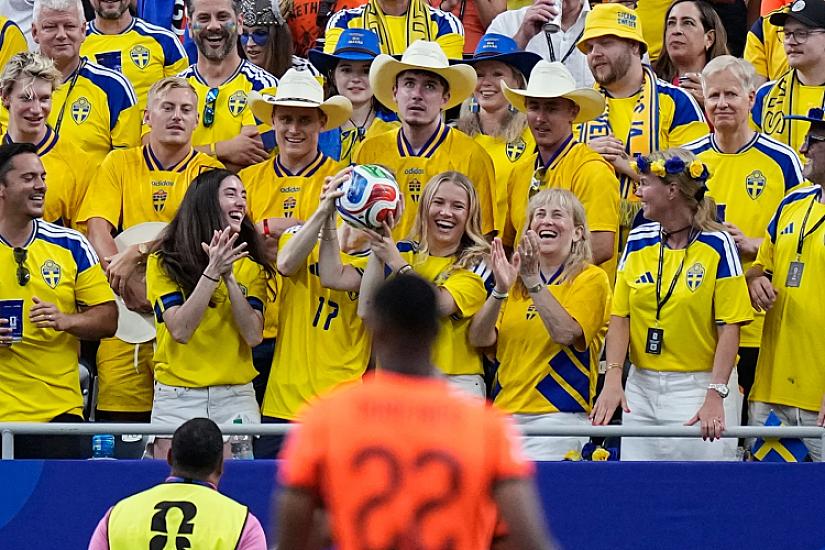

We have seen this in many football matches, and we also see it in the 23rd World Cup held for nearly a month: the ball on the field flies into the stands, but it does not remain with the fans; it is returned.
Medianews.az reports that according to the rules of the International Football Federation (FIFA), fans cannot keep the ball that falls into the stands. Therefore, stadium staff immediately act to return the ball. The fans themselves do not keep the ball for long. Some take a souvenir photo with the ball when it lands in their hands and soon throw it back onto the pitch. Undoubtedly, this is a precious moment for those who have traveled a long way and spent money to watch the World Cup.
English fan Jack Goodwin, who came to the World Cup from London with his father, emphasized in a statement to the US "Associated Press" agency that he does not find the demand to return the ball to the field fair: "We have spent so much money on this trip... I should have the right to keep the ball I caught in the stands. We spent part of the money we saved to buy a house on this trip."
The "Associated Press" notes that baseball fans in the USA can keep balls that come into the stands as lifelong souvenirs. However, such a tradition does not exist in football. Why? FIFA has not explained the reason for this. Experts believe that this rule is related to tradition, economic factors, the continuous flow of the game, and the complex technology of the balls.
Football historian Charles Cotton recalled that in the past, only one ball was used during matches. When the ball fell into the stands, it was necessary to return it immediately so that the game could continue. Although there are now spare balls in different parts of the pitch, the tradition of returning the ball that flies into the stands has not changed.
The "Adidas Trionda" ball used in the 2026 World Cup is considered one of the most technological footballs ever made.
Hand-stitched 32-panel leather balls are long gone. The new ball has four panels and is made from welded polyurethane. This material does not absorb water, making it lighter and better able to maintain its stability as it is used.
The most important feature of the ball used in the 2026 World Cup is the 500 Hz frequency motion sensor embedded inside. A 500 Hz frequency means 500 full rotations (cycles) per second. The sensor inside the ball transmits data to the Video Assistant Referee (VAR) system, helping to clarify offsides and other contentious incidents.
The system also precisely determines whether the ball has crossed the goal line. According to experts, the sensor operates with 99.99% accuracy in practice and together with stadium cameras can calculate the position down to the tip of the player's shoe.
But does this system work when "Adidas Trionda" balls leave the stadium?
Experts say that the mentioned electronic system can only work in conjunction with special equipment installed in stadiums where World Cup matches are held. In other words, the ball practically loses its technological capabilities outside the stadium.
Additionally, the balls used in the 2026 World Cup are charged pre-match with a special wireless energy filling system similar to that of smartwatches.
Taking all these into account, it does not seem likely that in the near future the balls in the World Cup matches will be allowed to remain with the fans. Nevertheless, experts do not rule out the possibility that the rules may change in the future.
Toğrul Əli,
Medianews.az