
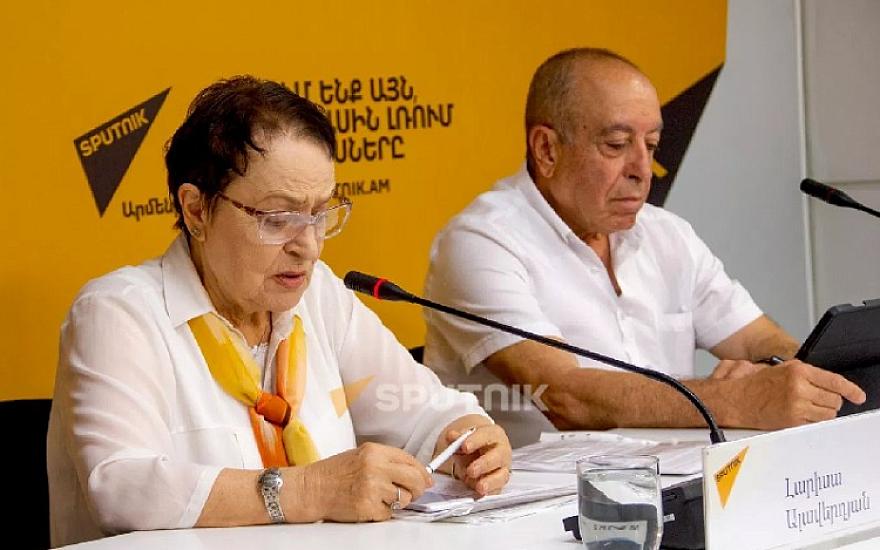
Forces unwilling to allow the road connecting the main part of Azerbaijan with the Nakhchivan region to become operational have become active again. On July 27, a press conference was held in Yerevan solely on this issue. According to Medianews.az, at the press conference titled "Change in the Balance of Power in the Region: Risks for Armenia," human rights defender Larisa Alaverdyan and political scientist Migran Shahzadean expressed statements against Trump's International Peace and Prosperity Route (TRIPP). They highlighted that protests came from Russia and Iran against the background of the US and Armenian governments signing documents to implement the project.
Emphasizing that the idea of creating a corridor passing through Armenia touches upon the interests of neighboring countries, Larisa Alaverdyan noted that the project directly hinders Iran's relations with Armenia and for this reason is perceived by Tehran as a threat to its national security, provoking rightful dissatisfaction.
Larisa Alaverdyan quoted the thoughts of Zbigniew Brzezinski, who served as the US president's national security adviser from 1977 to 1981, stating Washington should have pressed Russia out of the South Caucasus 30 years ago, characterizing TRIPP as an expression of this desire.
Migran Shahzadean emphasized that the road to be opened to Nakhchivan under US patronage touches upon the interests not only of Iran but also of Russia, asserting that the project would jeopardize Armenia's security.

Born in 1943, Larisa Alaverdyan is from Baku and received pedagogical education in the Azerbaijani capital. She actively supported the aggression aimed at separating Karabakh from Azerbaijan.
Larisa Alaverdyan is the head of a department at the Russia-Armenia (Slavian) University in Yerevan. During the rule of Robert Kocharyan, Armenia's staunchly pro-Russian president, she served for two years (2004-2006) as ombudsman.
The former ombudsman openly declares that she cannot imagine Armenia's security without Russia, and considers Moscow as Yerevan's main strategic ally in the region.
Larisa Alaverdyan's statements, which consistently oppose the Nikol Pashinyan government, completely coincide with the position of Russian-oriented forces in Armenia. She criticizes the government for pursuing a pro-Western policy, claims the country is entirely controlled by the West, and calls the parliamentary election held in June 2026—which resulted in the defeat of pro-Russian opposition forces—the "most disgraceful and dirty election in Armenia's history."

Migran Shahzadean was the rector of the Yerevan Innovative Technologies Institute in 1998, the year Robert Kocharyan became President of Armenia, and he left this post one year after Kocharyan's presidency ended (in 2009). During his tenure as rector, he also served as the head (1999-2002) of the Moscow State University of Economics, Statistics and Informatics' regional center in Yerevan and as director (2002-2009) of the Yerevan branch of the same university.
Migran Shahzadean, a full member of the International Open Education Academy in Moscow, currently teaches political science at the Yerevan branch of the Russian Economic University named after Plekhanov. He is firmly opposed to Armenia's Western-oriented foreign policy, claiming that distancing from Russia and Iran would lead Armenia into geopolitical isolation.
Statements by Larisa Alaverdyan and Migran Shahzadean have been extensively covered on the website of "Sputnik Armenia," the Armenian branch of the Russian international news agency "Sputnik," under the headline "TRIPP project limits direct connections between Yerevan and Tehran."

On August 8, 2025, in Washington, the President of Azerbaijan and the Prime Minister of Armenia met and signed a peace declaration in the presence of US President Donald Trump. The foreign ministers of the two countries also initialed a draft agreement on establishing peace and interstate relations between Azerbaijan and Armenia.
In Washington, it was mutually agreed to create a corridor passing through Armenia that would connect the main part of Azerbaijan with the Nakhchivan Autonomous Republic. This project, set to be realized under US patronage, was named Trump's International Peace and Prosperity Route (TRIPP). In 2026, the governments of the US and Armenia signed relevant documents regarding the project.
Novator.az reminds that as early as the summer of 2025, US media noted that the peace declaration signed between Azerbaijan and Armenia, thanks to Donald Trump's determination, was a strategic blow to the Iranian regime.

At that time, on the "Fox News" channel's internet page, an article was published based on the opinions of Iranian experts—journalist and human rights defender Banafsheh Zand, who lives in the US, and Behnam Ben Taleblu, the chief scientific officer of the Democracy Defense Fund headquartered in Washington.
Banafsheh Zand told "Fox News" that, as stipulated in the declaration, leasing TRIPP to an American company for 99 years would be a huge gain for the US and a blow to the Tehran regime: "Donald Trump's intervention results in the creation of a new, vital trade and security corridor that bypasses Iran completely, connecting the Caspian Basin with Europe. The corridor will give Washington direct control over the delivery of Caspian hydrocarbons to Europe. The US will control railways, roads, telecommunications networks, and energy pipelines along the corridor. This will grant American companies a dominant position in the regional transit of oil, gas, and goods. By managing this transportation artery, the US will not only secure trade and investment worth billions of dollars but also provide Europe with alternative supply routes reducing dependence on Russia and Iran."
Banafsheh Zand also told "Fox News" that the Washington agreement could in the future result in the establishment of US military bases in the region: "This corridor is a nightmare scenario for Iran. Tehran has long benefited from its geographic position in managing energy and trade flows. The new agreement achieved between the US, Azerbaijan, and Armenia represents US entry into the region and deprives Iran of this leverage."
Behnam Ben Taleblu emphasized in his statement to "Fox News" that TRIPP shows how vulnerable Iran is in the Caucasus: "Armenia's defeat to Azerbaijan in the recent war, as well as political problems between Moscow and Yerevan, make it difficult for Iran to reap real benefits from its traditional economic and political relations with Armenia. Iran is essentially excluded from this route."

Thomas de Waal, a Carnegie Endowment staff member, international expert on the Armenia-Azerbaijan conflict, and journalist, wrote in his analysis published at that time in the "Foreign Affairs" magazine that US President Donald Trump, through diplomatic skill, achieved significant progress: "Both Baku and Yerevan want to escape Moscow's influence. The Trump administration aims to secure commercial benefits for the US and strengthen the president’s peace-loving image by supporting the agreement. However, the agreement reached in August is still very fragile. It can only be successful if it helps open the roads closed by the war. For this, Washington needs to cooperate with Armenia, Azerbaijan, and Turkey in financing and infrastructure construction. Only then will the route named TRIPP function not as a local project but as an international highway.
The US must also build close cooperation with the European Union because Brussels invests more politically and financially in the region. European support is crucial for lasting peace between Armenia and Azerbaijan. Moscow naturally wants the rapprochement achieved through US mediation to fail. But if Washington and European partners actively participate in implementing the transit agreement and take measures against internal and external sabotage, the South Caucasus can be extracted from the conflict vortex that hinders its development."
The analyst noted that Iran is also dissatisfied with the corridor connecting Azerbaijan to Nakhchivan, does not want to lose its transit role, and does not accept a route under US control./novator.az