

In the second part of our series on the history of the World Cups, we travel to the most turbulent and dramatic years of football. In the first article, we spoke about the traditions established by the 1930 and 1934 World Cups.
Now, the focus is on the World Cups of 1938 and 1950, held in the shadow of the approaching disaster and the great comeback after the 12-year break caused by World War II. These two tournaments were not just football games, but reflections of an entire era, political intrigues, and human tragedies on the green field.

World Cup 1938: The footsteps of war and Brazil’s early complacency
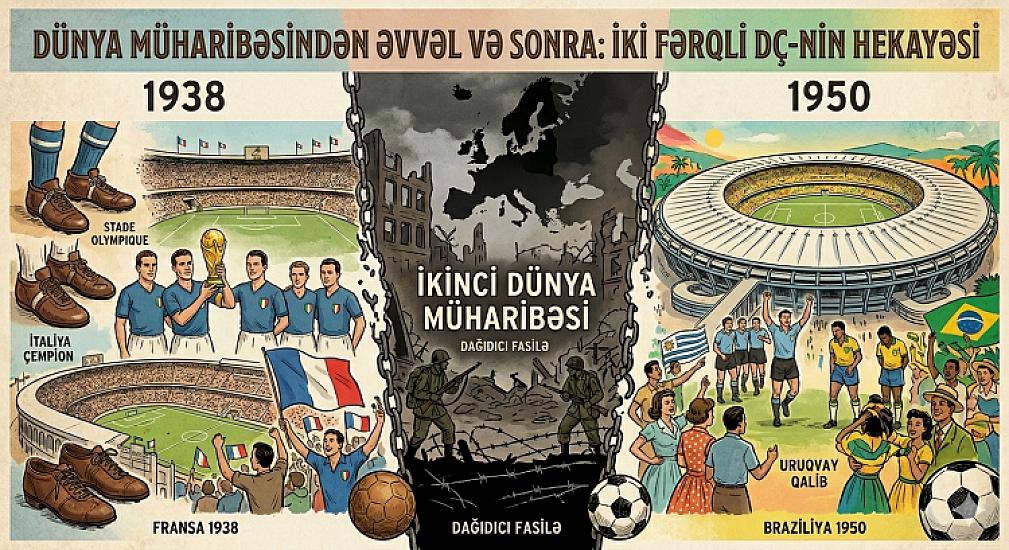
It is impossible to separate the third World Cup from the rapidly escalating political tensions in Europe. There were two main candidates to host the tournament: Germany, which had successfully organized the 1936 Olympics, and Argentina, which relied on the principle of alternating the tournaments between Europe and America. However, FIFA president Jules Rimet used his influence to move the tournament to its homeland, France.
This decision particularly angered South American countries. Argentina, Uruguay, and the USA boycotted the tournament, asking, "Why Europe twice in a row?". Spain was sidelined due to the civil war. The strangest political event befell the Austrian national team. Austria, which had qualified with a strong lineup, was annexed by Germany (Anschluss) just before the championship and ceased to exist as a country on the map, so it could not participate in the tournament.

Among the tournament's memorable moments was the match between Brazil and Poland in the first round, which went down in World Cup history in golden letters. The game, starring Brazilian Leonidas and Polish Ernest Wilimowski, ended with Brazil winning 6-5. Wilimowski became the first player in World Cup history to score four goals (a poker) in one game. Interestingly, due to heavy rain that made some Brazilian players' boots heavy with mud, it is claimed that Leonidas played part of the match barefoot.
The biggest mistake of the tournament was Brazil's complacency displayed in the semifinal against Italy. South Americans were so sure they would reach the final that they rested their best player Leonidas on the bench and even bought their plane tickets in advance to Paris, where the final was to be held. Although Italy’s coach Vittorio Pozzo suggested the Brazilians “whoever wins keeps the tickets,” the offer was declined. Italy eventually won. Angered Brazilians refused to sell their tickets, forcing the Italian team to travel to the final by train.
In the final, Italy defeated Hungary 4-2, becoming world champions for the second consecutive time. Vittorio Pozzo went down in history as the only coach to win two World Cups. By the way, this tournament was the first to use smooth footballs with an internal bladder instead of the traditional laced ones.

World War II: The trophy hidden in a shoebox
The Second World War, which began in September 1939 and ended the lives of millions, halted football for 12 years. The most interesting football story from this dark period concerns the fate of the “Golden Goddess” World Cup trophy. Although the German fascists searched Italy thoroughly to seize the trophy, the Italian football official Ottorino Barassi safeguarded it by hiding it under a bed inside an old boot. At FIFA’s 1946 congress, he handed the trophy intact to the organizers. Thus, preparations for the great comeback began.

World Cup 1950: The great comeback and the "Maracanazo" tragedy
Emerging from the war with devastated economies, no European country wanted to host the tournament. In this difficult moment, Brazil took the initiative. They built the legendary “Maracanã” stadium in Rio, with an incredible capacity of 200,000 spectators for that time.
The effects of the war were evident in the list of participants. Germany and Japan were excluded as aggressors, and Eastern European countries (USSR, Hungary, Czechoslovakia) did not participate. Italy took part, but a core part of their team had been destroyed in the 1949 plane crash of the “Torino” club one year earlier.

This tournament also inscribed memorable moments in history. For example, the Indian team withdrew in protest against FIFA’s ban on playing barefoot. England made their first World Cup appearance but suffered a massive shock. The largely amateur US team defeated the English 1-0. Before the match, English media mocked the Americans and could not believe the result. Some newspapers even thought it was a telegraph error and printed scores like “England 10-1 USA.”
Brazil had imposed a strange format on FIFA to sell more tickets. There was no playoff; group winners advanced to a final group, where the champion was determined. In the last game of the final group, Brazil and Uruguay faced off. This was, in effect, the final.

Brazil only needed a draw to become champion. The entire country was in a celebratory mood. Newspapers ran headlines like “Brazil Champion” before the match, 22 gold medals were prepared for the players, and even FIFA president Jules Rimet had written his congratulatory speech in advance for the Brazilians. But Uruguay captain Obdulio Varela told his team in the locker room, "Underdogs never win. Don’t pay attention to the stands; the game will be decided on the field!"
Although Brazil scored early in the second half, Uruguay equalized in the 66th minute. At the 79th minute, Alcides Ghiggia capitalized on an error by Brazilian goalkeeper Barbosa and scored the goal that plunged the 200,000-strong stadium into deadly silence. Uruguay won 2-1 and became world champions for the second time.

After the final whistle, Brazil fell into genuine national mourning. People in the stands suffered heart attacks; some even committed suicide. Believing the team had brought bad luck, Brazil never wore the white kit again that they had worn in that match and switched to the famous yellow and green colors.
The goalkeeper Moacir Barbosa, blamed for the conceded goal, never escaped the public’s wrath throughout his life. Shortly before his death, he uttered one of football history’s saddest quotes: “In Brazil, the heaviest punishment is 30 years. But I have been serving a sentence for 50 years for a crime I did not commit.”

The 1950 World Cup went down in history as the greatest lesson on how unforgivable overconfidence and disrespect to an opponent can be in football. This lesson was also watched by a 9-year-old boy comforting his crying father in front of the television. That boy would later become known worldwide as “The King of Football,” Pelé. More on that in future articles…


