

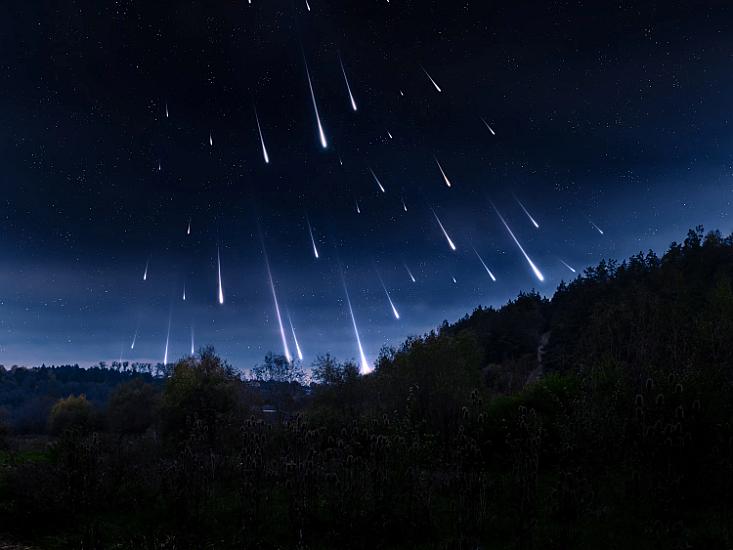

"The π-Puppid meteor shower will be observed at the end of April. The peak activity of the meteor shower will coincide with the dates April 22–24."
According to the news provided to Operativ Media by the Department of Astrophysics of the Faculty of Physics at Baku State University (BSU), although this meteor stream is better observed mainly in the Southern Hemisphere, it can sometimes be seen from the lower latitudes of the Northern Hemisphere under favorable conditions. The π-Puppid meteor shower is caused by the Earth encountering dust particles released by the comet "26P/Grigg–Skjellerup."
This comet has an approximate 5-year period around the Sun and releases many small particles into space each time it approaches. When the Earth passes through the region dense with these particles, a meteor shower is observed. The most interesting feature of this meteor stream is its instability: in some years, almost no meteors are seen, while in other years a sudden increase in activity (outburst) may occur, and dozens of meteors can be observed per hour.
These meteors enter the Earth's atmosphere moving at a relatively moderate speed. Their geocentric velocity is approximately 18 km/s. This speed is lower compared to faster meteor showers like the Lyrids, and therefore the π-Puppid meteors can sometimes create slower and longer visible trails. The radiant (the point from which meteors appear to originate) is located in the Puppis constellation in the southern part of the sky. For this reason, the meteor shower can be better observed in the Southern Hemisphere. Observing the π-Puppid meteor shower from Baku and, generally, from the territory of Azerbaijan is considered difficult. The main reason is the radiant's position very close to the southern horizon and that it is often below the horizon.
However, under very clear sky conditions and in areas with an unobstructed southern direction, it is possible to observe some meteors near the horizon. The most suitable observation time is during the night hours, particularly the interval after midnight.