

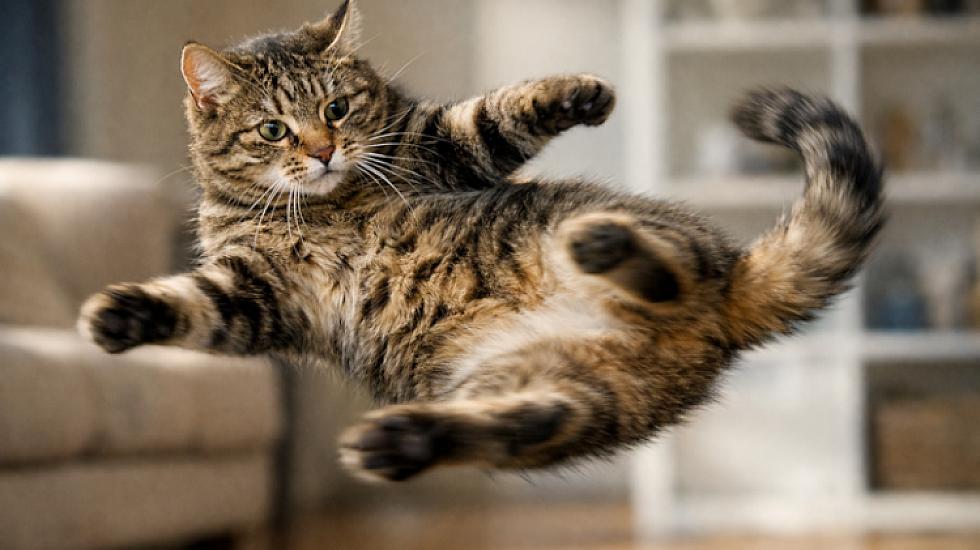

The question that has puzzled scientists for centuries has finally been answered: Why do cats always land on their feet? Researchers from Yamaguchi University in Japan explained how cats rotate themselves in the air and safely land on the ground.
Medianews.az, citing Milli.Az, reports that the researchers determined the secret of this extraordinary acrobatic ability lies in the highly flexible section of the spine on their back.
Tests conducted on cat spines, published in the journal "The Anatomical Record," showed that the thoracic spine of cats is almost three times more flexible compared to the lumbar spine. Thanks to this structure, cats can rapidly twist the upper part of their body like an artist and position themselves to face the ground within a few milliseconds. The study’s lead researcher, Dr. Yasuo Higurashi, stated that the thoracic spine rotates easily and this movement assists the rotation of the lumbar spine as well, enabling the cat to land on its feet.
The ability of cats to rotate in mid-air has been studied by physicists since the 1800s as the "falling cat problem." According to the laws of physics, a body should not be able to rotate by itself without external influence; however, cats appear to "break" this rule. Theories developed over two hundred years focused on three main models: tail propulsion, bend-and-twist, and squeeze-and-twist models.
Dr. Higurashi and his team conducted two experiments to observe the real mechanism:
Spinal analysis: Cat spines donated to the university were examined with a special device. It was discovered that the spine does not have uniform flexibility throughout; the part of the thoracic spine near the front legs has greater rotational ability.
Video recording: Two adult cats were dropped from a height of 1 meter and their movements were recorded on video. It was observed that the cats’ front torso rotated to face the ground a few milliseconds before the rear torso.
These findings confirmed that cats move according to the "squeeze-and-twist" model. Cats pull their front paws inward and quickly rotate their upper torsos while spreading their back legs to keep their lower torsos relatively stable. Then the process reverses: the back legs are pulled inward, the front paws spread, and the lower torso rotates. Since the upper and lower torsos rotate in opposite directions, the angular momentum remains unchanged and cats always land on their feet within the laws of physics.