
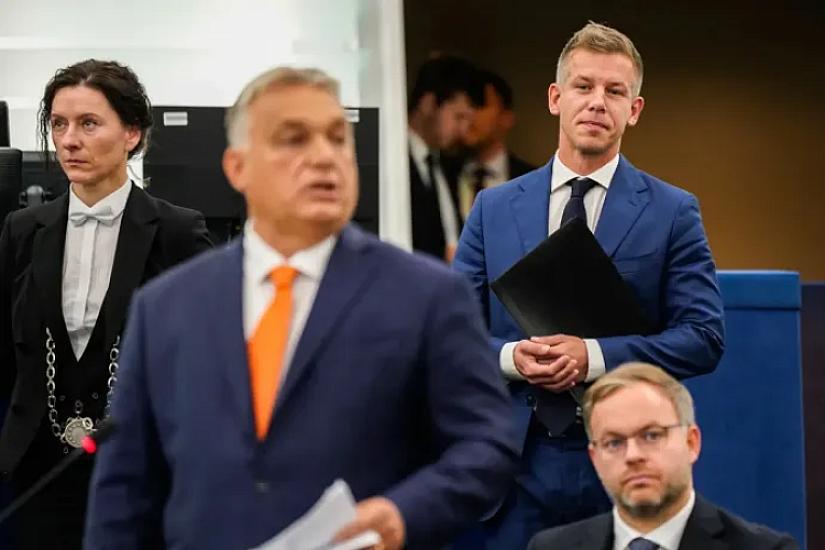
The statements that the foreign policy of the new government to be formed by the Respect and Freedom Party, led by Peter Macar, who won the parliamentary elections in Hungary, (including regarding Ukraine) will not differ from the policy of the Orban government are far from the truth.
It is difficult to understand why there was a need for disinformation about what Peter Macar said at the press conference, when learning it takes only 2 minutes.
P. Macar stated that he will not veto the allocation by the European Union of a 90 billion euro credit to Ukraine, because this matter is already settled and the decision was made last December. He simply said that Hungary would not contribute to this aid because a very complex economic situation has arisen in the country. Indeed, Hungary currently has a serious need for the European Union’s aid, and P. Macar is trying for the quick release of EU funds that were frozen during the Orban era.
Answering a question about the Russia-Ukraine war, P. Macar emphasized that Ukraine is the victim of this war and everyone in Hungary knows this. According to him, no one has the right to tell Ukraine anything from outside about reaching an agreement under certain conditions: “If Hungary’s territories were occupied, we would not give up our territories, that would be betrayal...”
P. Macar announced that, like with all neighbors, they will establish friendly relations with Ukraine and that he will meet with Zelensky soon. He said he will not call Putin, but if Putin calls, he will talk to him and ask him to stop killing people in Ukraine: “This would probably be a short conversation...”
P. Macar assessed Russia as a threat, recalling that Hungary has faced this threat in its history. He believes that the European Union and individual member states must be prepared for this. Regarding energy cooperation with Russia, P. Macar said that his government will try to diversify sources, increase competition in this area, buy the cheapest energy, and ensure the country’s energy security, but this does not mean renouncing Russian oil. He noted that after the Ukraine war ends, the EU will anyway lift sanctions against Russia and will restore cooperation with this country.
The only negative point regarding Ukraine in P. Macar’s stance is his opposition to Ukraine’s accelerated accession to the EU. P. Macar also expressed this position during his election campaign. (During previous years, Orban has so demonized Ukraine through relentless propaganda that it is not easy to express positive opinions about this within the country.) According to him, a country at war cannot be accepted into the EU and many member states think so too; after the war, Ukraine, like other countries, must meet the organization’s criteria for membership.
Identifying Peter Macar and Viktor Orban ideologically is also wrong. The fact that both are right-wing and represented the same party for a period does not mean they share the same views on all matters. Right and left are very broad concepts, and it would be ridiculous to talk about unity among all right-wingers, as well as among all left-wingers. Viktor Orban started his political career as a liberal-democrat but later, as a typical opportunist kleptocrat, moved towards the far right—strong conservatism and populist nationalism—in the interest of maintaining power. Peter Macar is center-right and a liberal conservative. In general, people like Orban are chameleons ready to assume any color for personal gain and political interests; they do not have a stable and principled ideological position.
Şahin Cəfərli,
political scientist