
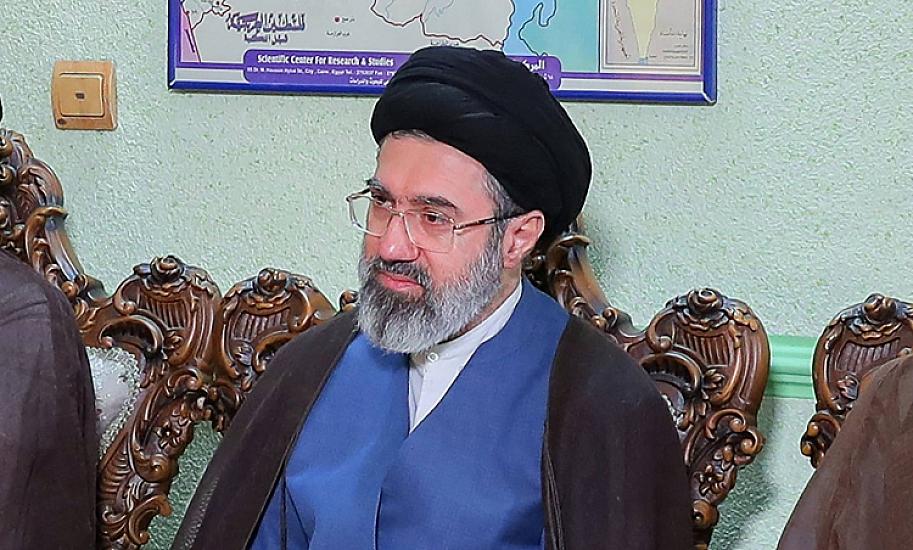
While the US and Israel continue their airstrikes – during a time of ongoing war, a new leader has been appointed in Iran. According to information released by state media, Mojtaba Khamenei, the son of the Supreme Leader Ali Khamenei who was killed on February 28, has been elected as the country's new supreme leader.
Medianews.az reports that the US "New York Times" newspaper published an article titled "Iran's new leader: Ayatollah Khamenei's son is a mysterious figure" on the matter.
The article states that Mojtaba Khamenei's appointment means that Tehran has no intention of backing down before Israel and the US, and that the existing hardline theocratic course will continue.
The newspaper emphasizes that even within Iran itself, information about Mojtaba Khamenei is quite limited: "For many years, he has been known as a shadowed yet influential figure within his father’s circle of power. Mojtaba Khamenei has played an important role in coordinating the activities of military and intelligence structures at the supreme leader's office. It is reported that he has very close relations with the Islamic Revolutionary Guard Corps (IRGC) and is considered one of the most supported individuals by that institution."
The article notes that 56-year-old Mojtaba Khamenei holds the necessary religious status – the title of ayatollah – to be elected supreme leader: "He has taught for a long period in Shia religious schools. Nevertheless, there is little information about his personal views and political stance. Mojtaba Khamenei rarely appears before the public and almost never speaks. Now, however, he is not only Iran's supreme religious and political leader but also the supreme commander of the country’s armed forces."
Vali Nasr, a Middle East expert from Johns Hopkins University, told the "New York Times" that this election is both unexpected and significant.
According to Vali Nasr, Mojtaba Khamenei’s selection means the continuation of his father's political line, and he was seen as a figure who could consolidate power faster than other candidates. Nasr points out that although Mojtaba Khamenei had long been discussed as a potential successor, this topic was mentioned less frequently over the past two years.
The "New York Times" writes that according to some sources, Ali Khamenei had told his close circle that he did not want his son to succeed him and explained that the supreme leadership position should not become hereditary power: "After all, the 1979 Islamic Revolution overthrew the monarchy precisely by the slogan of ending hereditary rule."
However, Mojtaba Khamenei's election as supreme leader indicates that power circles in the country – high-ranking clerics, the IRGC, and influential politicians – have closely united under conditions of war and crisis to make this decision. Among these circles, Ali Larijani, Secretary of the Supreme National Security Council, is also a key figure.
Known as a pragmatic politician, Larijani currently plays a leading role in the country's governance and is considered a long-time ally and friend of Mojtaba Khamenei. Both individuals wield significant influence within Iran's armed forces.
The IRGC was originally an ideological military structure created to protect the Islamic Republic and its borders. Intended as an additional security shield against potential coups or fragmentation within the army, this institution has evolved into one of Iran's most powerful political, military, and economic entities.
Currently, the IRGC mainly directs Iran’s ballistic missile and drone attacks against Israel, Persian Gulf countries, and US bases in the region. This process continues amid large-scale airstrikes carried out by the US and Israel on Iranian territory.
Mojtaba Khamenei was elected to the supreme leader post by the Assembly of Experts, consisting of 88 members. This body is composed of high-ranking Shia clerics and, according to the Iranian constitution, has the authority to elect the supreme leader.
Interestingly, on the day the assembly discussed the new leader’s election, Israel struck a building in the city of Qom – one of the main religious centers of the Shia world. Traditionally, meetings of the Assembly of Experts are held in that building. However, according to "Fars" agency, the building was empty and for security reasons, the clerics held the meeting online.
During the discussions, the majority of the clerics in the assembly supported Mojtaba Khamenei’s candidacy. They believed that given Iran’s current situation, he possesses the necessary experience and capabilities to govern the country. Some clerics viewed the election of the ayatollah's son, who had been killed by the US and Israel, as a sign of respect for his political legacy."
Tehran analyst Mehdi Rahmati told the "New York Times" that under current conditions, Mojtaba Khamenei's election is the most logical option: "Because he closely understands all mechanisms related to the management and coordination of security and military structures. In fact, many of these operations were already under his supervision."
At the same time, Rahmati noted that this decision could create new tensions within Iranian society. According to him, a large part of the population opposes the governance model of the Islamic Republic, and transferring the supreme leadership within the family could cause significant dissatisfaction: "Some segments of society will react harshly and negatively to this decision. This could have a backlash."
The "New York Times" writes that Ayatollah Ali Khamenei was the final decision-maker in all major state issues in Iran: "He took a hard stance against domestic reforms and did not make significant concessions in nuclear negotiations with the US.
In January of this year, the harsh suppression of widespread protests across the country was carried out under his orders. According to human rights organizations, security forces killed at least 7,000 people during the dispersal of those protests."
According to the Iranian government, Mojtaba Khamenei’s family also suffered heavy losses due to US and Israeli strikes after the war began. During the attacks, his wife Zahra Adil, mother Mansureh Khojastah Bagherzadeh, and one of his sons were killed.
Other main candidates for the supreme leader post included cleric and legal scholar Alireza Arafi and Seyyed Hassan Khomeini, the grandson of Ayatollah Ruhollah Khomeini, the founder of the Islamic Revolution.
Arafi was one of the members of the three-person interim leadership council formed after Ayatollah Khamenei’s death. Both Arafi and Khomeini are considered more moderate figures. Khomeini is particularly known for his closeness to Iran’s pressured reformist political camp.
Some analysts believe that unlike his father, Mojtaba Khamenei may be inclined toward certain reforms. They think he represents a younger and more pragmatic generation of clerics and may face less resistance from hardline supporters due to his lineage.
Mojtaba Khamenei’s close politician Abdolreza Davari says that he might initiate changes similar to the modernization course implemented by Saudi Arabia’s de facto leader Mohammed bin Salman.
Davari says that Mojtaba Khamenei is one of the rare figures who could take steps toward reducing tensions in relations with the US: "If anyone can move in this direction, it is him. If another leader took such a step, they could face serious resistance from the ruling elite and conservative forces."
Washington’s stance toward Mojtaba Khamenei’s rise to power remains unclear for now.
US President Donald Trump said during a press conference in Washington that since the war began, many of the individuals the US administration saw as possible Iranian leaders have been killed: "Soon it will be the case that we won't recognize anyone anymore."
In response to a question about the worst-case scenario regarding Iran, Trump said: "The worst case is that we do all this and in the end someone comes to power who is no different than before. That could happen. But we don’t want that to happen."