


An investigation has been presented on the NTV channel broadcasting from Cologne, Germany, about the United States testing new weapons in Iran. Sarvan Səmədoğlu, an Azerbaijani journalist living in Germany, translated into Azerbaijani the text of the extensive material about the investigation conducted by NTV correspondent Markus Lippold.
Medianews.az presents the investigation to its readers.
In the first days of the war in Iran, both sides used thousands of rockets, including cruise missiles and drones. The US and Israel targeted sites in Iran, while the regime in Tehran responded with attacks on Israel, US military bases, as well as on facilities of the Gulf countries and ships in the Strait of Hormuz.
So, which specific weapons are used by the parties participating in the war? For what purposes are these weapons employed?
It turns out that the US uses not only known systems but also new weapons. As in Ukraine, the Middle East is becoming a testing ground for modern warfare methods. Let us take a brief look at the main weapons used by the US.
Aircraft carriers
Before the war began, the US concentrated its largest military force in the Middle East since 2003 — when it attacked Iraq. This includes the "USS Abraham Lincoln" operating in the Arabian Sea and the Gulf of Oman, and the "USS Gerald Ford" positioned in the Mediterranean Sea, the world’s largest and most expensive warship. These vessels carry dozens of fighter jets and are escorted by a navy fleet including destroyers equipped with missiles. Additionally, submarines are active in the combat zone.
Cruise missiles
Both destroyers and submarines launch "Tomahawk"-type cruise missiles. Their long flight range and striking power, enabling them to destroy strategic targets such as military bases, make them among the most important weapons. It is believed that one such missile fell on a girls' school in the southern Iranian city of Minab, causing the deaths of over 170 people.
Thus, "Tomahawk" missiles, which are stealthy on radar for the first time, were used. Their black coating absorbs certain wavelengths of radar beams, reflecting less.
According to military expert Gustav Gressel, another cruise missile used is the "AGM-84 Harpoon." Initially intended for maritime targets, it can now also be used against land targets. From the air, various versions of AGM-158 JASSM missiles are employed.
According to the "New York Times," during the initial waves of attack, precision-guided glide bombs such as the "AGM-154 Joint Standoff Weapon" were used (a glide bomb is a fixed-wing aircraft that can glide without any energy source). Their advantage is that the bomb is released from a distance outside enemy air defense reach and silently glides about 130 km to the target with the help of its wings. Control systems ensure high accuracy. Expert Gressel also states that glide bombs of the "GBU-39 Small Diameter Bomb" type are used to precisely destroy hangars and protected aircraft.
Bombs and missiles
At the beginning of the war, Iran's air defense positions were neutralized through glide bombs. After achieving air superiority, simpler and cheaper bombs could be used. These include the "Joint Direct Attack Munition" (JDAM), which is equipped with an additional GPS system to convert ordinary bombs into highly accurate ammunition. The "New York Times" writes that these bombs have become the Pentagon's "favorite tool" for air strikes in wars since the September 11, 2001 attacks.
In the Iran war of 2026, "Precision Strike Missile" (PrSM) missiles are also used for the first time. These short-range ballistic missiles launched from a ground platform are successors of ATACMS missiles known from the Ukraine war, but have a flight range exceeding 500 km. These missiles were added to the US military arsenal only in 2024.
Drones
One of the new weapons developed by the US military is a weapon much cheaper than cruise missiles: a drone named "Lucas." It is a kamikaze drone that flies directly to the target and explodes, and is used only once. The "Low-Cost Uncrewed Combat Attack System," inspired by Iran's "Shahed-136" drone, was developed after a sample of the "Shahed-136" was captured and dismantled, and a new model created based on it. This drone is used for the first time in the current Iran war. Its flight range is approximately 800 km, and the cost of one unit is about 30,000 euros. For comparison, a single "Tomahawk" missile costs more than 1 million dollars.
Another famous drone is the "MQ-9 Reaper." This drone is used in Iran both for reconnaissance and for attacks on air defense positions. According to "CBS News," Iran has managed to shoot down 11 of these drones.
Bombers and fighter jets
Among the bombers and fighter jets used by the US are four jet-powered B-2 stealth bombers; this is probably one of the world’s most expensive combat aircraft. The B-1 bomber, capable of supersonic flight, is also used. The B-1 can carry more bombs and is suitable for large-scale air strikes. They also have distinct appearances: the B-2 has a bat-wing shape, while the B-1 has variable-sweep wings that can be adjusted to different positions.
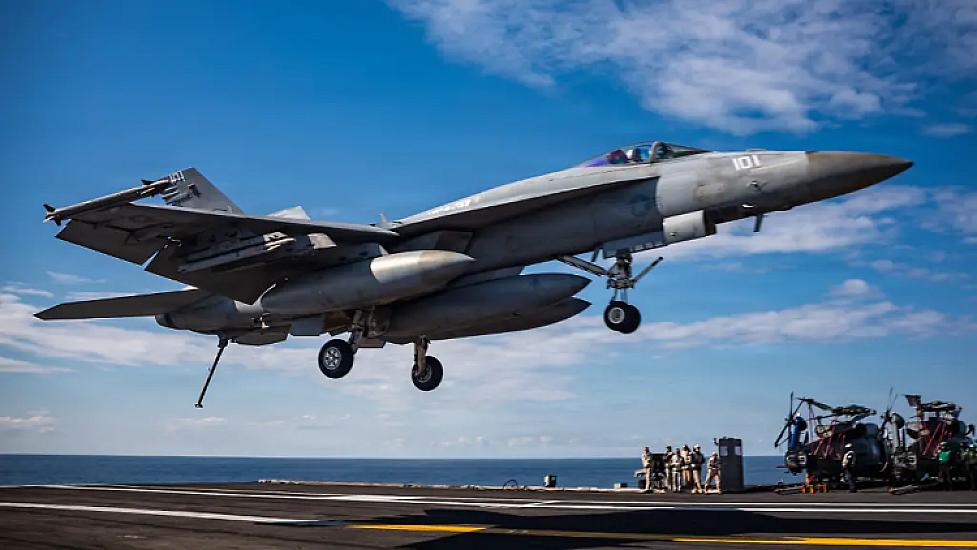
According to the "US Central Command," responsible for the Middle East, various fighter jets are used in Iran: F-16, F/A-18, F-22, F-35, and A-10.
A plane of special attention is the EA-18G. This aircraft is used for electronic warfare. The EA-18G is capable of disabling enemy communication and radar systems with jamming devices. In addition, many aircraft are used for aerial reconnaissance, early warning, communication, supply, and refueling.
Air defense
The ability to repel attacks plays an important role in the Iran war. The US uses "Patriot" air defense systems for this purpose; they can intercept aircraft, cruise missiles, and ballistic missiles. One battery can create a defensive "shield" over an area of approximately 160 km radius.
The "Patriot" system is equipped with PAC-2 or PAC-3 missiles. This system and missiles are also in high demand in Ukraine. The start of the Iran war has further limited their availability, as the Gulf countries attacked also use this system. The problem is that Patriot missiles worth millions of euros are used to shoot down very cheap kamikaze drones mass-produced by Iran. This creates an ammunition shortage problem.
Additionally, the US uses the mobile THAAD (Terminal High-Altitude Area Defense) system. This system is designed to destroy short and medium-range ballistic missiles, as well as some intercontinental missiles. The US Navy uses SM-2 and SM-3 missiles for air defense.