

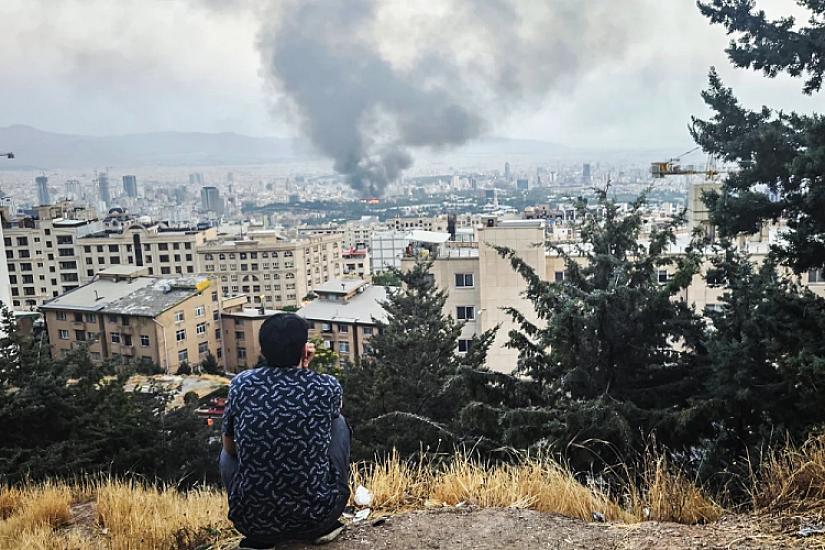

In Iran, which has been subjected to a military attack by the US and Israel, in which direction might events unfold?
Possible versions:
- transition of the religious regime to a softer model;
- transition to a course of partial normalization of relations with the West and Israel;
- abandonment of the religious regime, transition to a secular governance system;
- the country falling into a vortex of harsh internal confrontation and fragmentation...
Which seems more realistic?

Political analyst Xagani Jafarli, answering Medianews.az’s question, stated that the main question remains in which direction the processes in Iran will develop as a result of the US and Israel's military attack: “Considering that the US policy towards Iran is part of Washington’s Middle East policy, it can be said that the White House will not be interested in a strong central government in Iran. The federalization of Iraq and the final stages of federalization in Syria create the impression that Washington is interested in the federalization of Iran as well. The only reason Iraq and Syria have not been fragmented so far is that the US is not interested in that. If the interim head of state of Syria, Ahmad al-Sharaa, has survived until now, it is due to the support provided by the US.”
According to Xagani Jafarli, preference will be given to a weak central government and a federal state model in Iran: “Achieving this appears very difficult. Because unlike Iraq and Syria, there are several peoples in Iran striving for self-determination. It will not be easy to convince the Kurds, Baluchis, Lors, and Arabs to accept a two-state Iran model. Moreover, unlike Iraq and Syria, there is a high possibility that several regional states will interfere in a military intervention against Iran. If the Arab countries of the Gulf participate in a military intervention, they will have demands after the war. This could be the recognition of the Ahvaz Arabs’ right to self-determination. The Ahvaz region, which if an independent state, has been described as a second Kuwait, possesses rich oil and gas fields. The US might be inclined to share this wealth with a small Ahvaz emirate rather than a large Iran. If this happens, it will be difficult to preserve Iran's territorial integrity.”
However, the fragmentation of Iran also carries serious risks. If Iran is divided, Iraq and Syria will immediately break apart. The territorial integrity of Pakistan will also face a serious test. In other words, today, not only the fate of one state but also that of dozens of peoples and several states in the region is being decided in Iran. The absence of a precise scenario or project for Iran’s future is for this reason.”
Nailə Qasımova,
Medianews.az