

The wars of the new century no longer begin with declarations of victory, but with the shattering of old perceptions about power. The Iran campaign, which started on February 28, 2026 with "Tomahawk" strikes, demonstrated by its twelfth day that the era of short and sterile precision operations is now history.
Before us stands a new type of confrontation, not a repetition of past US scenarios, where even technological superiority does not guarantee a political outcome. The lightning-fast regime collapse plan quickly turned into a multilayered, exhausting, and long-lasting war.
Here, the target is not only military facilities but also global markets, logistics lines, the psychology of elites, and the resilience of allies.
In the first 72 hours, the US and Israel pinned their hopes on the classic "decapitation" strategy. The elimination by strike of Ali Khamenei at his residence in Tehran was a rare event in modern history. There is no analogue to a strike of this scale on an active supreme religious-political leader.
The military calculation was clear: to destroy the decision-making center, paralyze the power vertical, and leave SEPAH without coordination.
In the first stage, this tactic yielded some results. Within the first 48 hours, SEPAH units were operating scatteredly, and a unified chain of command was not felt. The coalition aviation took advantage of this and destroyed about 60 percent of the stationary air defense and electronic warfare systems.
Strikes with GBU-57 bombs on the Fordow and Natanz facilities reportedly pushed Iran’s nuclear program back to the level of the 2010s.
Against this backdrop, the illusion arose that the regime would soon collapse. The departure of some mid-level officials from the country, signs of management gaps, and some army units in Sistan and Baluchistan joining the protesters seemed like the start of internal dismantling.
However, this is precisely where the main limit of external power was revealed. The apparatus can be destroyed, but ideology cannot be wiped out instantly.
Khamenei’s death did not break the conservative core; on the contrary, it mobilized it further. For the remnants of SEPAH, this event was not a defeat but a sanctification of the conflict. The war shifted from a fight for power to one of revenge.
Tehran’s response formed not in the sky but in the economy. Understanding that chances were limited in direct aerial confrontation, Iran shifted the game to global weak points.
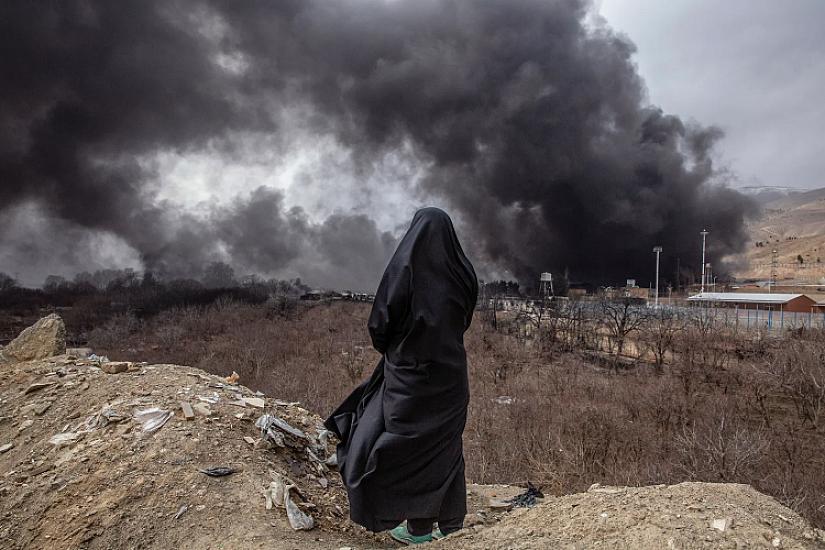
The blocking of the Strait of Hormuz with "smart" mines and swarms of kamikaze drones paralyzed the artery through which more than 20 percent of the world’s oil shipments pass.
The price of Brent crude oil exceeded $120, and with this, Tehran proved that even if it loses its leadership and military assets, it still retains the ability to strike not only the coalition but the global economy as a whole.
The regionalization of the conflict further intensified the effect. Missile attacks on oil refineries in Saudi Arabia and the UAE were a clear message to the Gulf monarchies. The cost of participation in Washington’s strategy will be paid directly.
The closure of airspace over Riyadh and Abu Dhabi for attack missions complicated coalition operations and forced the US to rely on more vulnerable maritime platforms.
Meanwhile, "Hezbollah" opened an additional front against Israel, loading the "Iron Dome" system with a mass of cheap drones. Thus, a new reality was formed where expensive defense technologies lost their superiority against cheap and mass means.
The international reaction showed even more clearly the scale of the shift. China chose active neutrality. It criticizes the US in political statements but is not interested in the destruction of the oil infrastructure on which its industry depends. Moscow directly benefits from rising energy prices and the diversion of Western attention.
Europe is once again fragmented. Paris calls for a ceasefire, while Eastern European capitals stand with Washington.
This is precisely why these twelve days have already gone down in history as the collapse of mutual illusions. Washington saw that even when heavily hit, Iran does not collapse after the first strike. Tehran understood that nuclear blackmail is no longer a guarantee of deterrence.
The first phase has ended, but the result is not the victory of either side. The real outcome is that the Middle East has entered a long-term phase of war. Here, the cost will not be measured in kilometers of the front line but in inflation, the nervous tension of allies, the collapse of old balances, and the moral erosion of states.
This is no longer a campaign.
This is the beginning of a new era of instability.
Elchin Alioglu,
political analyst