
An article about Iran’s territory, population, and ethnic-religious composition has been published on the website of the international TV channel "Al Jazeera," broadcasting from Qatar.
Medianews.az reports that, according to the presented statistics, Iran's territory is approximately 1.65 million square kilometers, and its population is 92 million people. This means it is the 17th largest country in the world in terms of both area and population.
The article emphasizes Iran’s important strategic waterways stretching from the Caspian Sea to the Gulf of Oman, including the Strait of Hormuz, through which approximately 20 percent of the world’s oil trade passes, highlighting the country’s geographical position that allows control over these routes.
The country’s nominal gross domestic product (GDP) is shown to be around 418 billion dollars, and it is noted that Iran ranks 36th in the world by economic size.
The unemployment rate is reported to be approximately 7.2 percent.
According to the article, the literacy level among the adult population is 89 percent, with this figure approaching 99 percent among youth, although there are differences between urban and rural areas.
Iran has rich oil and gas reserves: it ranks 9th in the world in oil production and 3rd in natural gas production.
The article recalls that Iran has land borders with seven countries: the longest border is with Iraq, followed by Turkmenistan, Afghanistan, Pakistan, Azerbaijan, Turkey, and Armenia.
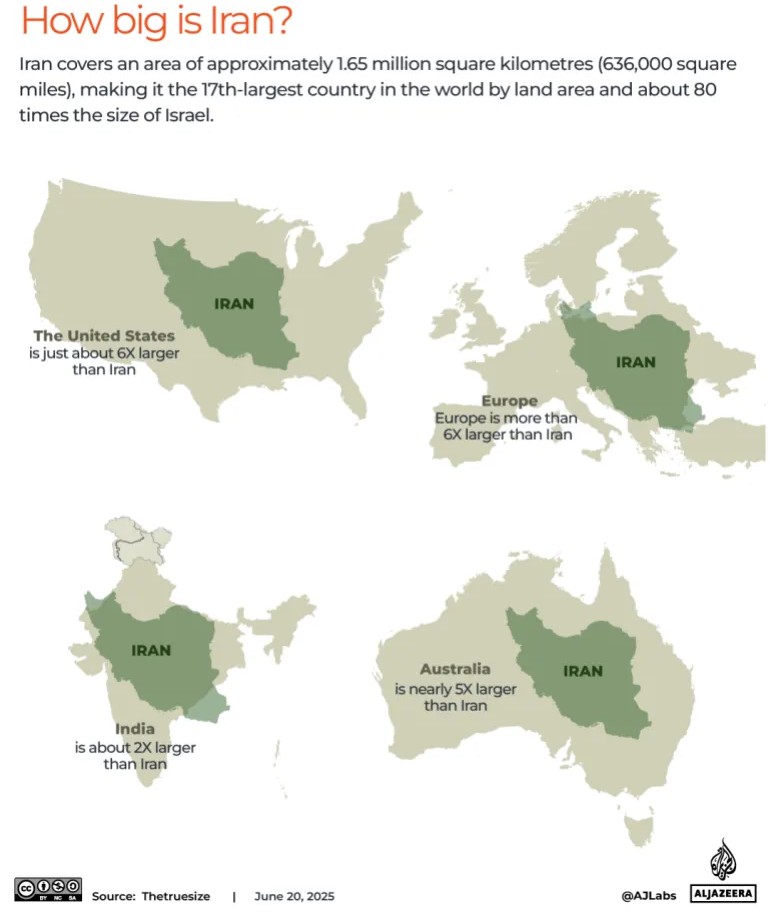
Iran’s territory is approximately six times smaller than the USA, about one-sixth of Europe, one-fifth of Australia, half the size of India, and approximately 80 times larger than Israel.
The majority of Iran's population is settled in the western half of the country.
The country’s largest city and capital, Tehran, has a population of 9.6 million.
Mashhad ranks second with a population of 3.4 million.
Isfahan with 2.3 million residents is the third-largest city in the country.
Among other major cities are Shiraz (1.7 million), Tabriz (1.7 million), Karaj (1.6 million), Qom (1.4 million), and Ahvaz (1.3 million).
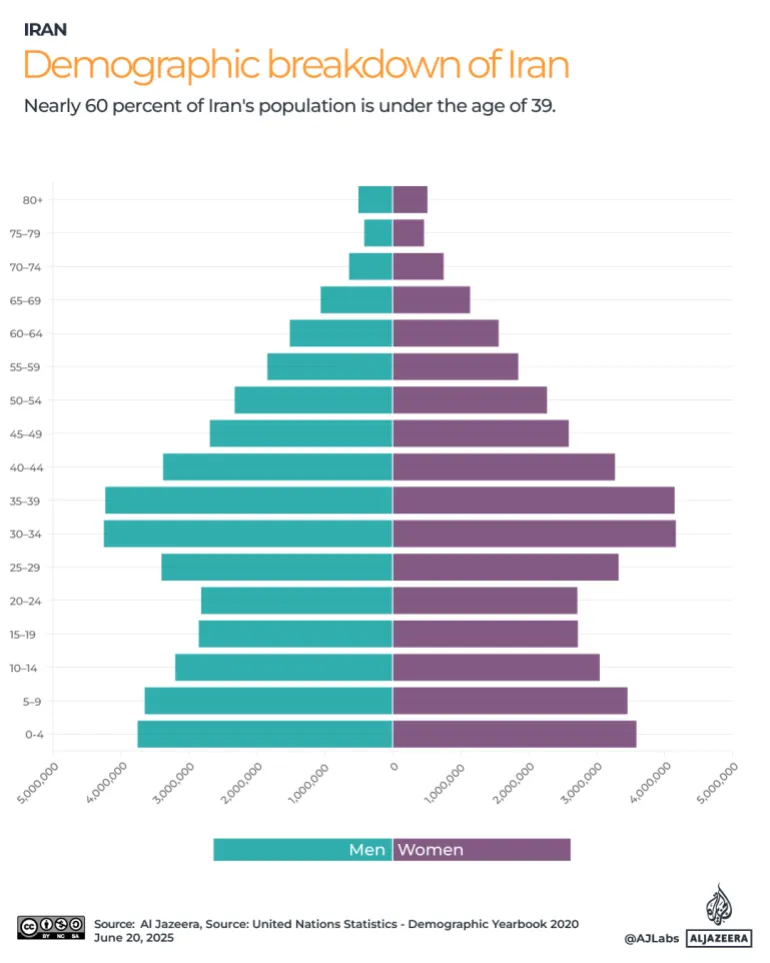
According to UN statistics, about 60 percent of Iran’s population is under 39 years old. The median age in the country is between 33-34 years.
77 percent of Iran’s population lives in urban areas.
The largest age groups are those between 30-34 and 35-39 years old, indicating that the majority of the population was born after the Islamic Revolution of 1979.
Later in the "Al Jazeera" article, referring to official data, it is stated that about 61 percent of the population are Persians, 16 percent Azerbaijanis, 10 percent Kurds, 6 percent Lors, 2 percent Arabs, 2 percent Balochs, and the remaining 2-3 percent are other Turkic-origin communities.
99 percent of the population are Muslim.
Of these, 90 percent are Shia, 9 percent Sunni and other Islamic sects.
The remaining 1 percent consists of religious minorities: approximately 300 thousand Baha’is, 300 thousand Christians, 35 thousand Zoroastrians, 20 thousand Jews, and 10 thousand Manichaeans.