
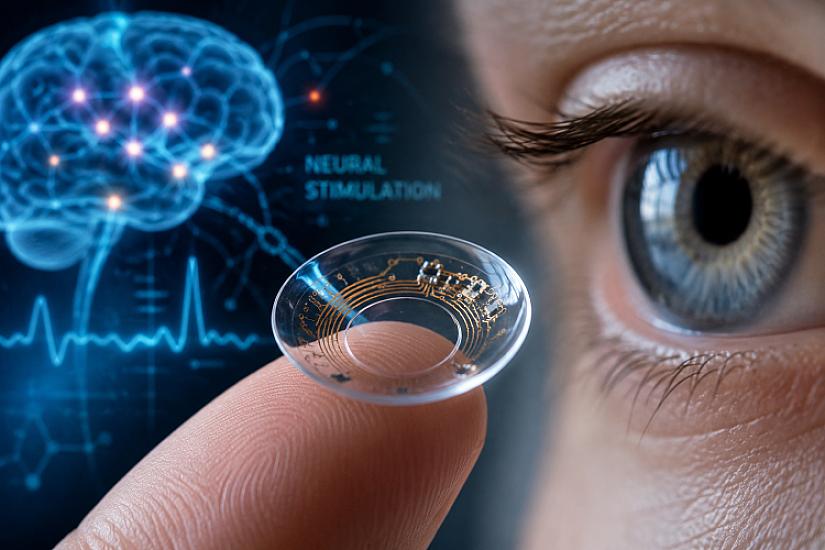
South Korean scientists have conducted research on a different approach to the treatment of depression.
Medianews.az reports that an article has been published in the journal "Cell Reports Physical Sciences" on this issue.
Researchers aimed to create new possibilities in the treatment of depression by developing a special contact lens that uses the connection between the eye and the brain.
Although millions of people worldwide struggle with depression, current drug treatments are not always sufficiently effective. For this reason, scientists are working on alternative and less invasive methods.
In experiments conducted on mice within the framework of the study, it was reported that contact lenses stimulating the brain were as effective as antidepressant drugs.
The article noted that contact lens treatment was applied for three weeks to mice with induced depression, resulting in positive changes in behavior, neural activity, and physiological indicators.
Can-Unq Park, a researcher at Yonsei University's Faculty of Materials Science and Engineering, stated that this study could open a completely new direction in the treatment of brain disorders through the eye.
Current depression treatments mainly target certain neural circuits through drugs, electroconvulsive therapy, and brain implants. Korean scientists tried to use the eye as a stimulating tool by utilizing the connection between the retina and the brain.
According to Park, since the eye is anatomically considered part of the brain, it was investigated whether a simple contact lens could provide soft and non-invasive influence on brain circuits.
The developed lens activates deep layers of the retina through two harmless electric signals, stimulating nerve connections that transmit signals to brain regions related to mood.
Scientists emphasize that this technology is not yet a fully validated treatment method. Its safety and effectiveness in humans have not yet been proven. Researchers believe that in the future, new neurotechnology methods requiring less intervention in the body could be developed.