

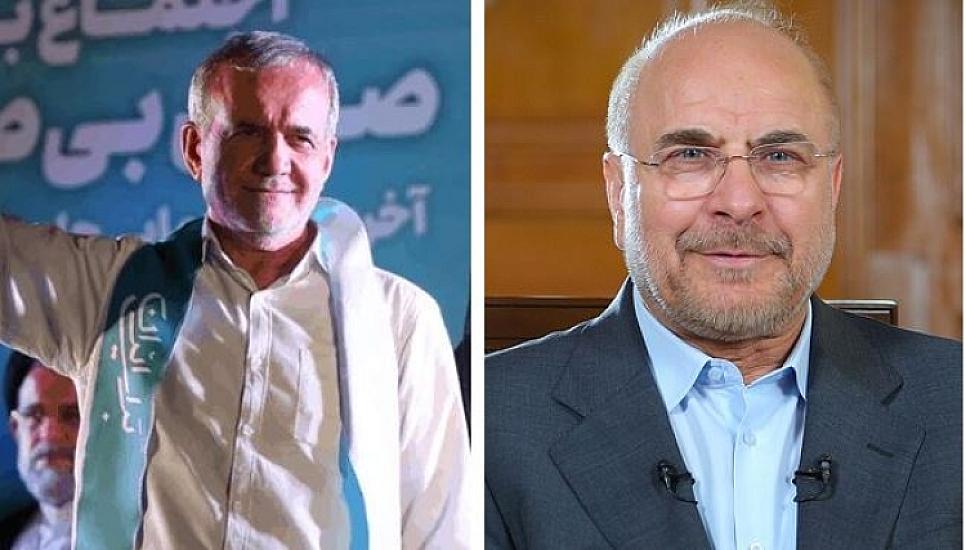

It is not a mere saying when US Vice President James David Wensin stated that Iran is effectively governed by the head of the country's parliament, Mohammad Bagher Qalibaf.
This indicates that the US leadership is well aware of what is happening in Iran, the positions of political forces, their levels of influence, and who makes strategic decisions.
In fact, this is not much of a secret. The events occurring in Iran and the statements of the prominent leaders show who controls the situation in the country.
Until February 28, it was clear to everyone that Iran was governed by Ayatollah Ali Khamenei and his team, especially the SEPAH generals. That is why the first targets were those included in this circle. The US leadership attacked as soon as it identified the main controllers of Iran and, in its own way, left the country leaderless.
At that time, it also became fully apparent that the legitimate president elected by the people two years ago, Masoud Pezeshkian, who had the confidence of millions of voters, was not included among those governing Iran.
Imagine, on the brink of war, the country's legitimate president was not invited to a meeting where three crucial decisions for the country’s fate would be made. This is an event that has never happened and will never happen in any country of the world.
The USSR also had a totalitarian regime; the country was governed by one party based on a unified ideology, but formally, the person elected by the people – the leader of the Supreme Soviet – was a member of the Politburo of the Central Committee of the Communist Party of the Soviet Union and participated in decision-making. For many years, one of the three main leaders of the USSR was the general secretary, another the prime minister, and the third the chairman of the Presidium of the Supreme Soviet. At certain times, in order to appear as a legitimate leader before Western countries, the person holding the position of party general secretary also held the position of the chairman of parliament.
Iran does not have such a concern. Receiving a vote of confidence from the people is a secondary issue for those who govern Iran.
Granted, Masoud Pezeshkian’s exclusion from the circle of those who govern Iran ultimately saved his life — he was not among those killed in airstrikes — but the fact remains that he was not given a role in the power vacuum created after the assassination of Khamenei.
After Khamenei, it was said that Iran was governed by Ali Larijani, the supreme leader’s adviser. Mojtaba Khamenei, appointed as the country’s supreme religious leader in place of his father, was wounded in the bombardment and could not carry out his duties (and still cannot govern), so Larijani emerged as the executor of the supreme leader’s powers. The US also targeted him, but again, Pezeshkian could not become influential in his country.
Because SEPAH started to manage Iran unambiguously and exclusively, and this military unit did not consider Pezeshkian as one of their own and trusted those like themselves. Both Larijani and the current individual said to govern Iran, Qalibaf, have worn SEPAH uniforms and led the corps.
Actually, since M. Qalibaf is the head of parliament, when he governs Iran, he cannot be considered illegitimate because he was also elected by the people, at least initially receiving votes from an electoral district’s voters, and then the parliament speaker was elected by persons chosen by the entire electorate of Iran.
But Pezeshkian became president with over 16 million votes. The most important thing is that at that time Mohammad Bagher Qalibaf considered himself unlucky and did not participate in that election. The conservative corps had put forward Saeed Jalili against Pezeshkian and had lost.
Now look at the situation: those who lost two years ago in the elections are, in fact, governing Iran and determining the fate of the country and the people.
In other words, there is currently no civilian authority in Iran. The US and Israel's attack has minimized the role of civilian authority and the influence of religious-clerical forces in this country. Iran is governed by the military forces led by SEPAH. They are also the ones conducting peace talks with the US. Foreign Minister Abbas Araghchi acts and speaks according to the instructions of Qalibaf, not the president.
It can be said that this is an abnormal situation related to war, and after the war, the branches of power will function according to their duties.
That will not happen. Iran has been governed like this for 47 years. None of the elected presidents have been influential in Iran, and they have always complied with the directives of the supreme leader. True, among them there were sharp politicians like Hashemi Rafsanjani and determined ones like Ahmadinejad, but ultimately, all accounted for the will of the supreme religious leader.
The person holding the post of supreme religious leader is not elected by the people but by a small group. The people have zero influence over that group. Such a governance system will continue in Iran for some time.
Khalid KAZIMLI