

In October 2025, official newspapers in Azerbaijan that were published six times a week reduced their frequency. Until then, only two newspapers were published six times a week: "Xalq qəzeti," published by the Presidential Administration, and "Azərbaycan," the organ of the National Assembly.
These newspapers abolished their Sunday issues and started publishing five times a week, leaving no newspapers in the country published six times a week.
At that time, seven other newspapers in Azerbaijan were published five times a week: "İki sahil," "Yeni Azərbaycan," "Yeni Müsavat," "525-ci qəzet," "Bakı xəbər," "Səs," and "Şərq."
The founder of "İki sahil" is the State Oil Company.
The remaining daily newspapers received financial support from the government to publish five times a week. The Media Development Agency allocated 15,000 manats per month to "Yeni Azərbaycan," "Yeni Müsavat," "525-ci qəzet," "Bakı xəbər," "Səs," and "Şərq," and 3,000 manats per month to their websites.

From 2026, only one issue per week of newspapers is financially supported: they receive 5,000 manats per month. Each newspaper’s internet edition gets 3,000 manats per month as financial aid.
Due to the reduction in financial support, "İki sahil" and "Səs" began publishing twice a week, while "Yeni Müsavat," "525-ci qəzet," "Bakı xəbər," and "Şərq" switched to weekly publication.
Currently, three newspapers are published five times a week: "Azərbaycan," "Xalq qəzeti," and "Yeni Azərbaycan."
The Russian-language newspaper "Novoye vremya" is published four times a week. The Media Development Agency had only financed one issue per week of "Novoye vremya," but the newspaper manages to publish three additional issues weekly at its own expense.
Among newspapers published twice a week, besides "İki sahil" and "Səs," there is also "Futbol+."
Among weekly newspapers, alongside "Yeni Müsavat," "525-ci qəzet," "Bakı xəbər," and "Şərq," there are also "Azernews" (English-language), "Azərbaycan müəllimi," "Azərbaycan Ordusu," "Bakinski raboçi" (Russian-language), "Cümhuriyət," "Ejednevniye novosti" (Russian-language), "Ədalət," "Ədəbiyyat qəzeti," "Həftə içi," "Hərbi and," "Kaspi," "Xalq Cəbhəsi," "Nedelya" (Russian-language), "Olaylar," "Olimpiya dünyası," "Paralel," "Təzadlar," "Türküstan," "Unikal," "Vışka" (Russian-language) newspapers as well.
Thus, among the main socio-political newspapers and sector publications published across Azerbaijan, three are published five times a week, one four times a week, and three twice a week. More than 20 newspapers are published weekly.
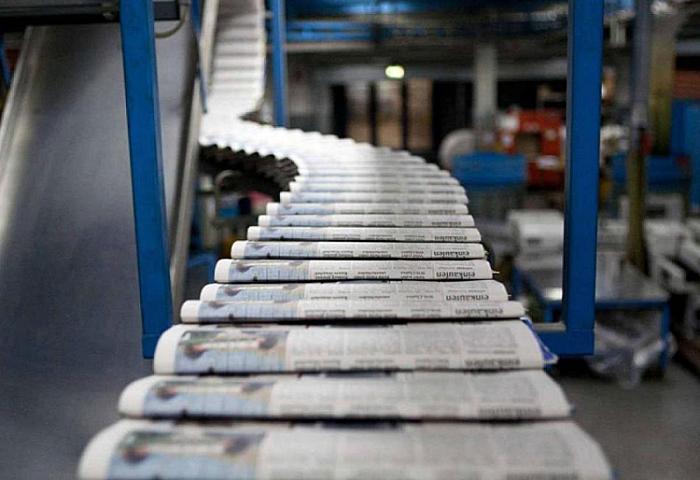
Medianews.az has also looked at the print circulation of one issue of socio-political newspapers.
One issue of "Yeni Azərbaycan" is printed in 4,919 copies, one issue of "Azərbaycan" in 3,317 copies, and one issue of "Xalq qəzeti" in 2,951 copies.
The circulation of one issue of "Novoye vremya" is 3,000 copies.
One issue of "İki sahil" is printed in 5,913 copies, and one issue of "Səs" in 2,000 copies.
Looking at the circulation of some weekly newspapers: "Bakı xəbər" - 3,050 copies, "525-ci qəzet," "Həftə içi," "Kaspi" (and the Russian-language "Kaspiy"), and "Unikal" - 2,000 copies, "Ədalət," "Türküstan," and "Yeni Müsavat" - 1,500 copies, "Bakinski raboçi" - 1,179 copies.
No newspapers are published on Sundays and Mondays. On Saturdays, only "Azərbaycan," "Xalq qəzeti," and "Yeni Azərbaycan" are published.
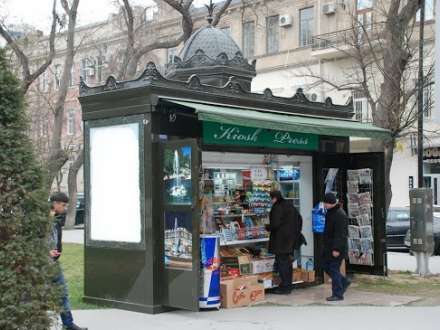
The decrease in daily newspapers has also led to changes in newspaper distribution. The staff of Baku Newspaper Distribution, the main media distributor of the capital, used to be off only on Sundays and Mondays until 2026; now Saturdays are also non-working days. The head of Baku Newspaper Distribution, Javid Rzayev, explained in an interview with Medianews.az that mobilizing the team for only three daily newspapers is not financially viable for the company.
Thus, since the distribution company does not operate on Saturdays, newspapers published on Saturdays reach kiosks several days later — on the following week's Tuesday. As a result, on Tuesdays, kiosks sell two issues of "Azərbaycan," "Xalq qəzeti," and "Yeni Azərbaycan" simultaneously — both the issue published that day and the Saturday issue.
So, how has the number of newspaper buyers changed after newspapers reduced their frequency?

Javid Rzayev, head of Baku Newspaper Distribution, said to Medianews.az that the number of newspaper buyers has significantly decreased since the frequency was lowered: "To be honest, I did not expect this. I thought, for example, if a daily issue of such and such newspaper sold 100 copies, after becoming weekly, it would at least sell 120-130 copies. Or at the very least, sales would remain around 100 copies. But sales have fallen. Imagine, the frequency of newspapers has decreased, meaning the number of copies released for sale has dropped, and in addition, purchasing power has weakened. Considering all these factors collectively, I can say that overall newspaper sales have decreased roughly tenfold."
Thus, the reduction in the frequency of newspapers delivers another blow to newspaper distribution. Will Baku Newspaper Distribution be able to withstand these blows?
Javid Rzayev says: "We will continue our work as long as we can. There is no other option. Only Russian-language newspapers and crossword newspapers have not seen a decline in sales levels. There has been no significant price increase for Russian-language newspapers. Their sales levels have remained the same. Although crossword newspapers have raised their sales prices, they have maintained their sales levels. Practically, today Baku Newspaper Distribution can continue functioning thanks to the sales of main crossword newspapers and Russian-language publications. If their sales fell too, probably we would no longer be able to operate."
Nailə Qasımova,
Medianews.az
Note: The article was prepared on the theme "Development of freedom of opinion, speech and information, and pluralism" with financial support from the Media Development Agency of the Republic of Azerbaijan and in accordance with the competition conditions.