

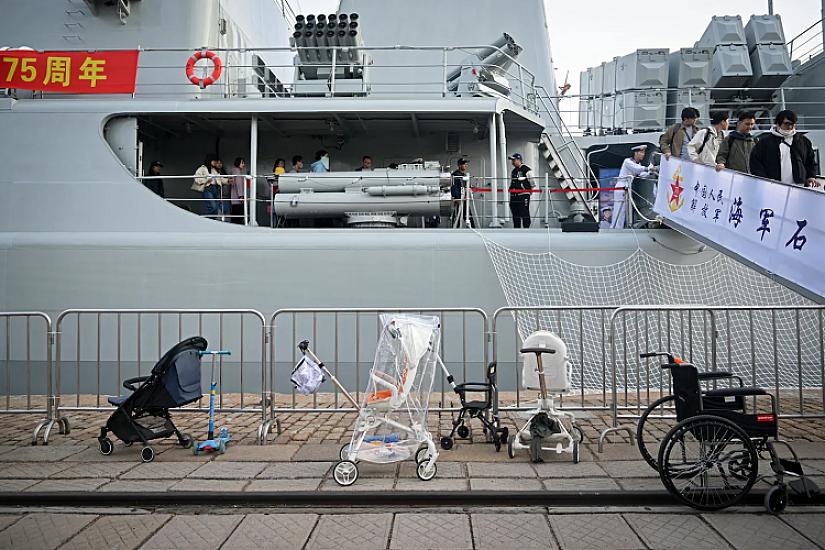

An editorial was published in the US "Washington Post" newspaper discussing the bitter consequences of the Chinese government's "one family-one child" policy implemented over 36 years, the efforts shown by the government in recent years to eliminate these consequences, but the demographic problems faced by the country having taken an irreversible character.

According to Medianews.az, the article states that based on the latest official statistics, the birth rate in China has fallen to its lowest level: "In 2025 alone, the number of children born in this country decreased by 17 percent compared to 2024.
The bitter experience of the communist regime governing China shows that centrally controlled family planning—even if it is "successful" as desired by the center—can lead to terrible and also irreversible results.
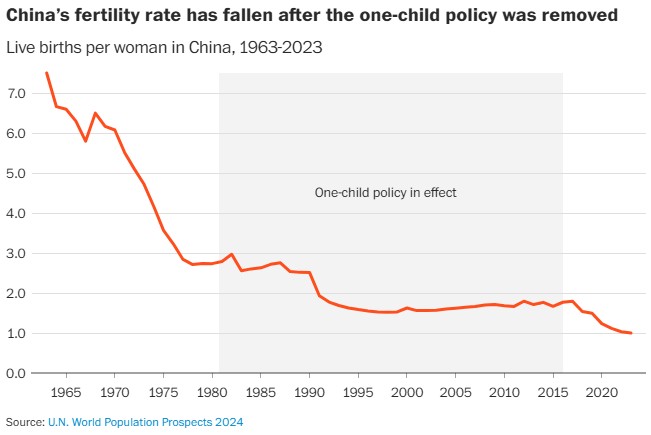
The Chinese authorities began implementing the "one family-one child" policy in 1979. The prohibitions that lasted until 2015, forced abortions, sterilizations, fines, and total propaganda resulted in the prevention of millions of births. During abortions, female fetuses were most often targeted.
China's Communist Party raised the child limit to two in 2015 and abolished it altogether in 2021. Nevertheless, China’s population has been continuously decreasing for four years. In 2023, China also lost its status as the country with the largest population in the world, being surpassed by India."
The "Washington Post" article states that new steps are now being taken in China to increase the birth rate: "The communist regime had granted tax exemptions on contraceptive pills for decades. This exemption has now been canceled. Currently, contraceptives are taxed at 13 percent. But will a 13 percent price increase on contraceptives really increase the number of births?
Today, China is a country where many young people have no siblings. The one-child policy lasted for such a long time that even the parents of these young people did not have siblings; as a result, the current young people and teenagers have no aunts, uncles, or cousins.

The current situation also complicates China’s military plans. China wants to reclaim Taiwan with military force, but war could result in the loss of the only child who would care for many Chinese families in old age.
Decades of abortions, particularly targeted at female fetuses, have seriously disrupted the gender balance in the country. Now, the number of men in China exceeds that of women by tens of millions. For this reason, some cannot have families or children.

Imposing taxes on contraceptives will not change the situation. Subsidies given to parents will not solve the problem at its root either.
Economist Milton Friedman once said: "If you leave the Sahara Desert in Africa to the government, there will be a sand shortage." It turns out that the communist takeover in China can even lead to a human shortage."