

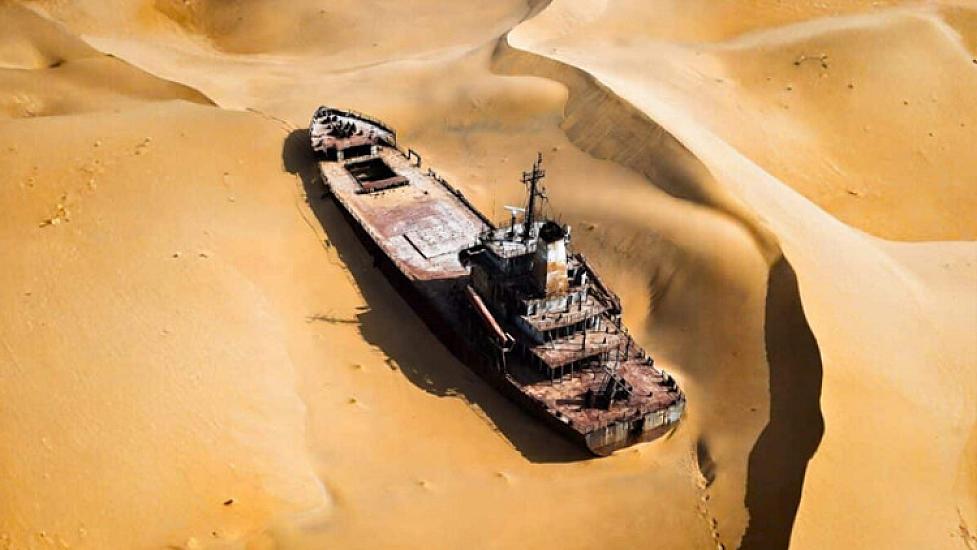

In April 2008, a geologist saw an object resembling a partially buried, round stone in the highly protected area of the U-60 diamond mine in Namibia. At first glance, the find did not resemble a treasure. Later, it was determined that this was a copper ingot with a trident emblem belonging to the "Fugger" banking family.
Medianews.az reports that this was written by "The Daily Galaxy".
This find was discovered in one of the least suitable places for investigating shipwrecks — a closed diamond zone Sperrgebiet near the Orange River on Namibia's southern coast. This area has never been disturbed by looters due to its harsh climate and strict protection.
As the sand was cleared, artifacts began to appear one after another: copper ingots, ivory, weapons, and navigation instruments. Later, an unusual cargo was discovered — over 2,000 gold coins, most of which were of Spanish, not Portuguese, origin.
Research determined that the ship was the Portuguese "Bom Jesus" ("Good Jesus"), which departed Lisbon on March 7, 1533, and disappeared.
Cargo and traces of history
The ship's identification was possible by combining various pieces of evidence. Some coins bear the image of King John III of Portugal, and it is known that these were minted between 1525 and 1538.
The ship’s cargo indicates it was traveling along Indian Ocean trade routes. It was not returning empty; rather, it carried metals and money to acquire valuable goods. However, researchers were surprised that about 70% of the gold coins were Spanish "excelentes".
Historian Alexandre Monteiro conducted archival research and found a document dating to 1533. According to the document, King John III sent a representative to Seville to collect 20,000 gold cruzados from Spanish investors. This fact explains the origin of the found coins.
The coast both destroyed and preserved
According to scientists, the ship was driven ashore by a strong storm and crashed into the rocks. The heavy copper cargo caused the wreckage to remain in place and prevented it from dispersing into the ocean.
As a result, the shipwreck stayed preserved under the sand for centuries. Archaeologists uncovered 22 tons of copper, ivory, weapons, wooden parts, and various tools. Approximately 23 kilograms of gold coins were also found.
This is considered a very well-preserved find for a 16th-century ship.
How was identity determined?
The 1755 earthquake, tsunami, and fire in Lisbon destroyed much of Portugal’s maritime archives. Therefore, researchers relied only on partially preserved sources.
The sources indicate that only one ship was lost off the Namibian coast during that period — the "Bom Jesus". Some documents note this name alongside the mark "lost". These facts strongly confirm that the shipwreck is indeed that vessel.
Excavations at the diamond mine
The excavations were conducted under unusual conditions. The area is located about 6 meters below sea level and is separated from the Atlantic Ocean by a protective wall.
The work was carried out in cooperation with the "Namdeb" company (a joint venture of "De Beers" and the Namibian government). One of the key figures in the project was archaeologist Dieter Noli.
Sand protected more than gold
Among the most notable of the finds were human traces. For example, inside a shoe compressed beneath wood, toe bones were found. Other human remains were found very sparingly.
This suggests that some of the approximately 300 people on board survived and managed to reach the shore. Their subsequent fate remains unknown.
According to UNESCO's 2001 convention, objects submerged underwater for more than 100 years are considered underwater cultural heritage. This find in Namibia is significant not only legally but also historically — it has preserved a rare "moment" of the 1533 trading world to the present day. (Qaynarinfo)