

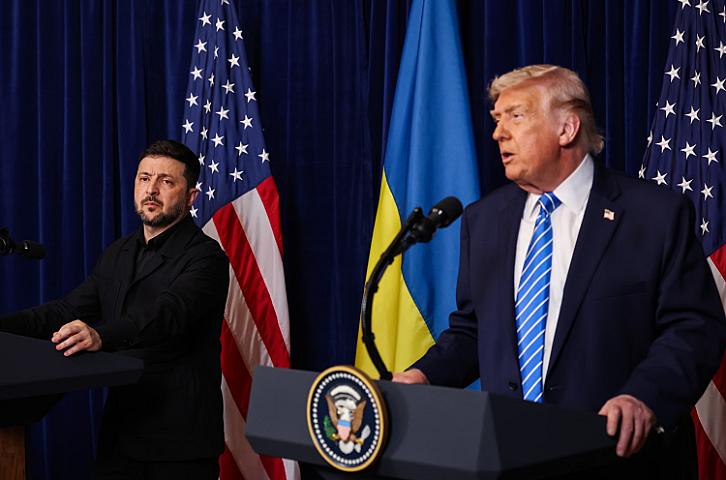

As long as international law and humanitarian values are disregarded, political relations fall into a tragicomic situation. The meeting held between Ukrainian President Volodymyr Zelensky and US President Donald Trump in the state of Florida was closely monitored by experts. After those discussions, Trump's statement about the Russian President that "Vladimir Putin wants Ukraine to succeed, and he does a lot for that" elicits a bitter smile. It is puzzling to understand Mr. Trump, who leads the world's number one power center, the USA.
How can one forget the murders committed against peaceful people in Ukraine, the erasure of cities from the face of the earth, the bombing of residential buildings, hospitals, and kindergartens right before the eyes of the modern world?
Naturally, war has its own rules. But the target should not be peaceful people, residential buildings, or hospitals. Supporting the aggressor in all respects after such severe crimes, instead of the victim, apparently stems from strategic commercial interests.
In the 12th century, while the East experienced a kind of renaissance period, the West was dominated by slavery principles. Does the old continent of Europe want to return to its previous era again today? In the 21st century, it is impossible to resolve the fate of a war through commercial approaches.
On the other hand, an unjust approach to the Russia-Ukraine war and yielding to official Moscow's demands pose serious threats not only to the countries of Eastern Europe but also to the former Soviet republics. This is precisely why there must be no compromise with the aggressor in this war, and the principles of international law, neglected today, must be applied to conclude the process.
Only after a just peace or a long-term ceasefire would it be possible to realize commercial objectives.
Əkrəm Bəydəmirli