

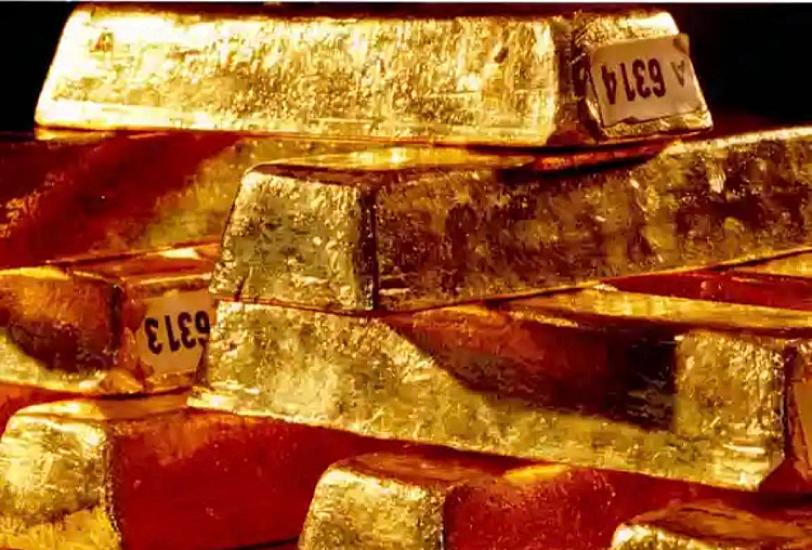

After the Greenland crisis between the US and Europe, the idea of bringing back Germany's gold reserves held in New York is gaining strength in Germany's economic and political circles.
US President Donald Trump's policies are forcing European countries, including Germany, to reconsider many issues. Trump's recent plans to annex the Danish territory of Greenland, which have dominated the agenda in recent weeks, and his threats regarding customs tariffs against Europe have caused concern in Germany's economic and political circles.
Demands to remove Germany's gold reserves worth 164 billion euros from New York have been on the agenda within the Bundesbank and various political circles against the backdrop of an uncertain global situation.
Emanuel Menz, the former head of the Research Department of Germany's central bank, the Bundesbank, stated in an interview with Handelsblatt newspaper: "Storing so much gold in the US currently seems risky."
Menz emphasized that it would be good for the Bundesbank to consider bringing back its reserves to obtain a more independent strategic position from the US.
Katerina Beck, spokesperson for the Green Party on financial policy, also brought up the topic of transferring gold reserves back.
"Gold reserves are an important factor for stability and trust. Under no circumstances should they be a toy in geopolitical conflicts," said Beck, emphasizing that it was reasonable to keep the reserves in Germany during Donald Trump's time in office in the US.
The European Taxpayers Association (TAE) also demanded the return of the reserves. TAE president Michael Jäger said: "Trump's actions are unpredictable; he does everything to gain profits. Therefore, our gold in the Federal Reserve System (FED) vaults in the US is no longer safe."
Jäger stated that the risk has increased and added that the Bundesbank is independent and can make this decision on its own: "The bank does not have to bow to politics."
The Bundesbank stores 1,236 tons of gold at the New York branch of the US Federal Reserve System.
However, Bundesbank president Joachim Nagel opposes such a step.
One of those who think similarly is Fritz Güntzler, spokesperson for financial policy of the ruling Christian Democratic Union (CDU), of which Chancellor Merkel is a member. He stated that storing part of the reserves in the US still makes sense and that "it is not useful to speculate publicly about withdrawing gold reserves under current conditions."
Frauke Heiligenstadt, spokesperson for financial policy of the Social Democratic Party (SPD), a junior coalition partner of the government, said she understood the concerns but stated that "there is no need for panic." She said, "Germany's gold reserves are well diversified. More than half are stored in Frankfurt, so we have the flexibility to act."
Heiligenstadt noted that New York is a reasonable location for the remaining portion of the reserves and emphasized that Germany, Europe, and the US are closely connected financially.
Michael Hüther, president of the German Economic Institute (IW), is also against bringing the reserves back.
"Due to monetary policy reasons, it may make sense to store gold for certain operations in the US," Hüther said, adding that bringing these reserves back to send a message to Trump would be meaningless.
Instead, he offered alternatives in the field of credit cards: "The European Union should see this dispute as an opportunity to strategically become more independent in payment systems. Currently, we are completely dependent on US companies Visa and Mastercard, which keeps us under pressure." Hüther demanded the urgent creation of alternatives.
Germany has the largest gold reserves in the world after the US.
Sarvan Samedoglu,
Germany