
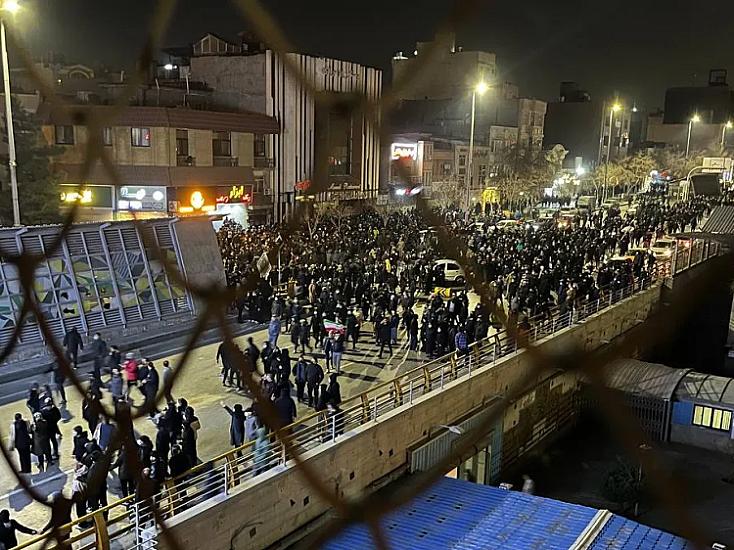
Medianews.az presents the chronology of the actions that began on December 28 in the Islamic Republic of Iran and rapidly spread across the country, resulting in a mass massacre:
December 28 — Protest actions begin in two large markets in the center of Tehran. The reason is the historical minimum drop of the Iranian rial against the dollar and the deepening of inflation. This sharply increased the prices of daily necessities in the country. The government's increase in the price of subsidized gasoline at the beginning of December also intensified the discontent.
December 29 — Protests spread from the capital to other cities. Mohammad Reza Farzin, head of the Central Bank, resigns. In Tehran, police disperse protesters with tear gas.
December 30 — Actions cover more cities and several universities. President Masoud Pezeshkian meets with businessmen, stating that the government will do its best to solve economic problems.
December 31 — Abdolnaser Hemmati is appointed as the new head of the Central Bank. In the southern city of Fasa in Fars Province, protests are accompanied by violence; the city hall building is stormed, and police officers are injured.
January 1 — Official first death reports are published: at least 7 people are reported killed. The most tense situation is recorded in Azna city of Lorestan Province. Videos circulated on social networks show fires in the streets and sounds of gunshots. The “Fars” agency reports that three people have died. There are also deaths in Bakhtiari and Isfahan provinces. In Lorestan, a 21-year-old member of the “Basij” forces dies.
January 2 — US President Donald Trump posts on the “Truth Social” platform, stating that if the Iranian authorities kill peaceful protesters, the US “will come to their aid.” Trump declares the US “fully prepared.” According to human rights defenders, protests take place in 22 of Iran's 31 provinces, in more than 100 settlements in total.
January 3 — Supreme Leader of the Islamic Republic of Iran, Ali Khamenei, says “the rioters must be put in their place.” This statement is considered a green light for security forces to intervene harshly. Protests spread to 25 provinces and over 170 locations. At least 15 people are killed, and 580 are detained.
January 6 — A sit-in protest takes place at the Grand Bazaar in Tehran; police use tear gas. The death toll reaches 36, including 2 members of the security forces. Protests are recorded in 27 provinces and more than 280 locations.
January 8 — Reza Pahlavi, son of the overthrown Shah of Iran living in exile (in the US), calls on protesters. The Iranian government cuts off the internet and international phone connections in the country.
January 9 — Authorities announce tough measures. Nevertheless, protests continue. Human rights defenders report at least 65 deaths and over 2,000 detentions.
January 10 — Protests reach their two-week mark. The death toll rises to 116. Prosecutor General Mohammad Mohahedi Azad declares participation in protests will be considered “rebellion against God,” recalling that the punishment for “rebellion against God” in Iran is death.
January 11 — Donald Trump states that after his threats, he has received an offer from Iran for talks. Activists report that the death toll has reached 544.
January 12 — Pro-government rallies are held in the country. Tens of thousands participate in the rallies. Unofficial reports say the death toll has reached 646.
January 13 — After several days' pause, Iranians can make international phone calls for the first time. Public activists say the death toll has exceeded 2,500. Trump announces he has canceled a planned meeting with Iranian representatives and declares “help for the protesters is on the way.”
January 14 — Iran emphasizes that it will respond to possible interventions by the US and Israel. Officials state that detained protesters will be rapidly tried and face the death penalty. At the end of the day, Donald Trump says he has received information that violence against protesters in Iran has decreased and that the regime does not plan mass executions of protesters.
January 15 — US and Iranian representatives face off at the UN Security Council. The US again threatens Tehran. An Iranian diplomat accuses Washington of direct involvement in turning the riots into violence.